


Cawston is a village in Norfolk, and it is graced with a large and splendid late-medieval church. Its most prominent feature is the tower—nearly 120 feet tall, and with a very stark appearance due to the absence of parapet, battlements, or pinnacles. Its predecessor was blown down in a storm in 1412; the replacement appears to have been under way by 1421. The church attached to it is mainly 15th century, apart from the chancel of c. 1300 and slightly later transepts.
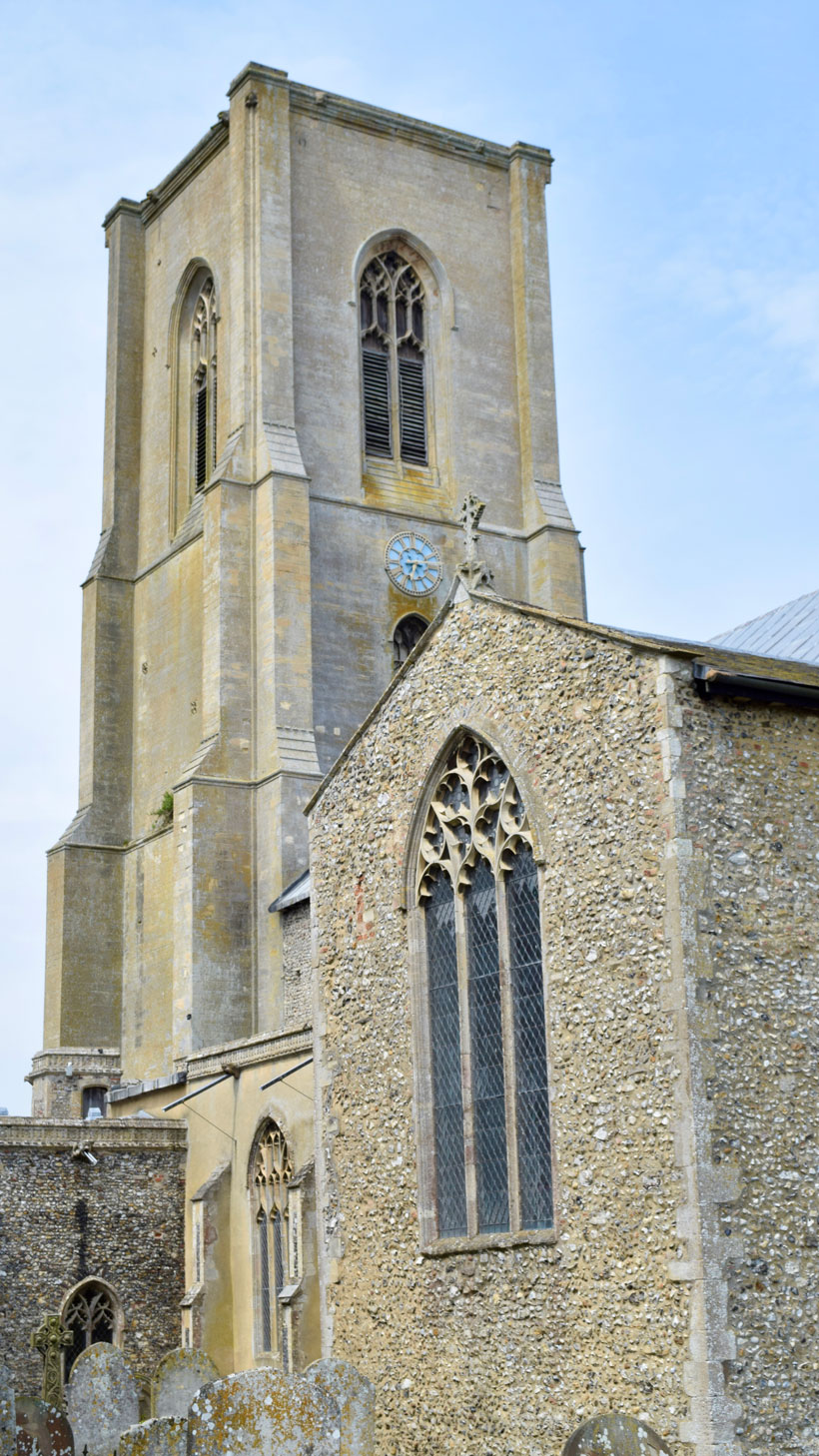 Inside, the tower has a decorated base course on all four faces, showing that the tower was complete before the nave was rebuilt. To the east, Cawston has one of the finest single hammerbeam roofs in East Anglia. Angels with spread wings stand upright on the ends of the hammerbeams. When was it built? In 1460 a Cawston man named John Barker made his will, leaving 10 marks (£6 13s. 4d.) toward both the roodscreen and to seating, both furnishings installed when a church is ready to receive them, suggesting that the nave was complete then, and that the roof was in place.
And then there is the screen. This was not painted until the end of the 15th century, according to documentary sources. Around 1490, William Atereth and his wife paid for painting eight panels on the north side, as the 18th-century historian Francis Blomefield tells us, and there were further bequests in 1492 and 1494 in the wills of William Howelyn and Robert Osbern.
In his will of 1504, Richard Browne left four marks (£2 13s. 4d.) to paint one pane of the screen. Unusually for East Anglia, the screen has doors, which are painted with the four Latin Doctors; Gregory’s face and papal tiara were defaced after the Reformation, but the vandals ignored the cardinal’s hat on Jerome. The other 16 panels feature the patron saint, Agnes, and Helena, and 13 Apostles, including Paul and Matthias, ending with an uncanonized saint, John Schorne.
Schorne was an early 14th-century parson of North Marston in Buckinghamshire, who was credited with curing toothache and gout, the latter symbolized by him conjuring the devil into a boot, as shown on the screen. The apostles are readily recognized by their emblems, such as Andrew with his cross saltire, or Bartholomew bearing the flaying knife, traditionally the instrument of his martyrdom. Matthew’s background as a former tax collector (Matt. 9:9) is recognized by his wearing spectacles.
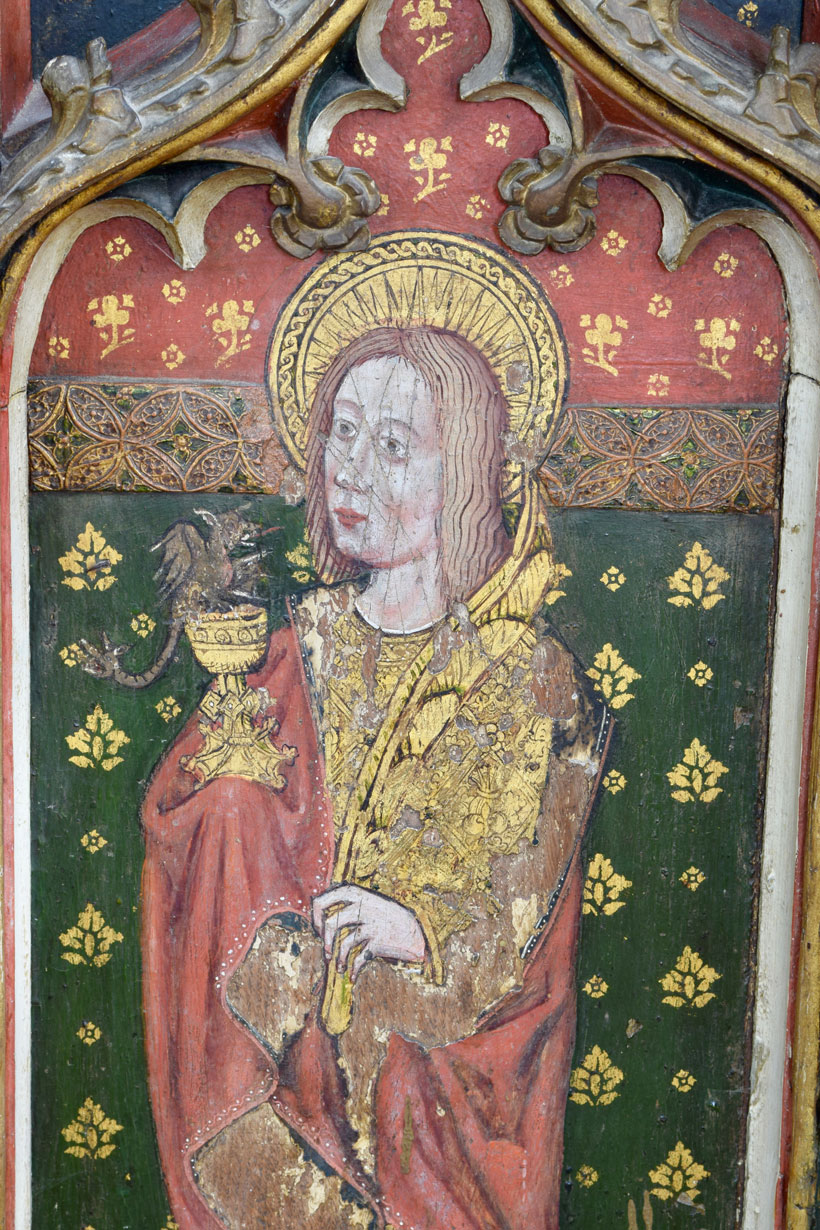 Traditionally the youngest apostle, John is depicted as a fresh-faced and beardless young man. Here he is depicted bearing a poisoned chalice (the poison symbolized by a dragon), whose contents he drank without coming to any harm, after he made the sign of the cross over it.
The Latin Doctors on the doors are by one artist; the eight panels on the north side and the first two on the south side are by a second artist; and the remaining six panels are by a third artist, possibly from the Netherlands, who painted these figures onto parchment, which was then stuck to the screen panels. A further feature of the screen is the use of gesso work on the buttresses and relief designs made in either chalk or plaster, subsequently gilded.
It must have been hard not to believe the Catholic and apostolic faith with these vivid depictions of the apostles staring at you squarely as you attended Mass.

Dr. Simon Cotton is honorary senior lecturer in chemistry at the University of Birmingham in the U.K. and a former churchwarden of St. Giles, Norwich, and St. Jude, Peterborough. He is a member of the Ordinariate of Our Lady of Walsingham.
