


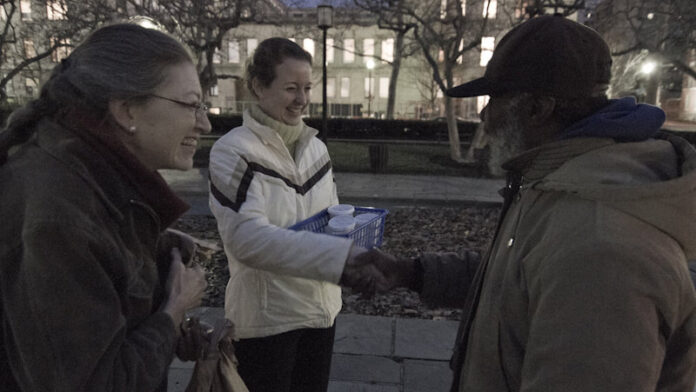
Since the mid-1980s, Tina Mallet has been involved in the ministry of St. Paul’s Parish K Street to the homeless population of Washington, D.C. She leads the Grate Patrol, which the Anglo-Catholic parish began in 1981. It is named after the grates over the city’s subway system, where people lie during the winter because of the hot steam they release.
On the morning of August 14, at around 6 a.m., Mallet went to an area south of the U.S. Institute of Peace, just a few minutes’ walk from the Lincoln Memorial, where she knew a number of people living in tents.
“I heard from a friend that evictions were going to start taking place,” Mallet told The Living Church.
Three days earlier, on August 11, President Donald Trump announced he was deploying 800 National Guard members to the District and federalizing the city’s police department, known as the Metropolitan Police. He said it was a “historic action to rescue our nation’s capital from crime, bloodshed, bedlam and squalor, and worse.”
“Our capital city has been overtaken by violent gangs and bloodthirsty criminals, roving mobs of wild youth, drugged-out maniacs and homeless people, and we’re not going to let it happen anymore,” Trump said in a news conference.
Section 740 of the Home Rule Act, in effect since 1973, allows for the Metropolitan Police to be federalized whenever the president “determines that special conditions of an emergency nature exist.” Trump is the first president to use the privilege through executive action, invoking it as he described D.C. as one of the most dangerous cities in the world.
“In my experience that narrative is completely hyperbolic,” Mallet said. The unhoused residents she and her fellow volunteers encounter are very well-mannered, she said. “We rarely come across anyone who is violent in any way.”
Such is the case even when they have to wake them up very early to ask if they want breakfast. “Over all the years that I’ve been doing this, my overwhelming sense is that people are really nice and they’re very agreeable. And they’re glad to have a conversation with someone,” Mallet said.
Glenn Marsh, a parishioner at St. Stephen Martyr Catholic Church, assists Mallet in leading Grate Patrol. Together with a team of volunteers, they hand out 150 bags of food and about four gallons of coffee every Saturday and Sunday, starting at 5:45 in the morning. Volunteers prepare the food at St. Paul’s dining hall on Fridays.
That those experiencing homelessness find shelter is something Marsh and Grate Patrol volunteers have been praying for, for a very long time, Marsh said. Included in their prayers is that they receive housing and even medical care “in a caring and respectful way.”
“Homelessness has been a problem not only in Washington, D.C., but everywhere,” he said, “but that’s the prayers that, you know, they will be treated with respect.” He was in touch with Mallet on August 14 when he learned she was making rounds near her area in D.C.
In a statement, a group of faith leaders from various traditions, including Bishop Marian Edgar Budde of Washington and the Very Rev. Randolph Marshall Hollerith of the Washington National Cathedral, condemned both the takeover and the president’s pronouncements.
“Such sweeping language is both inaccurate and dehumanizing, increasing the risk of indiscriminate arrests and the use of excessive force,” they said. “From the White House, the president sees a lawless wasteland. We beg to differ. We see fellow human beings—neighbors, workers, friends, and family—each made in the image of God.”
Contrary to the president’s claims on crime, a year-to-date comparison released by the Metropolitan Police on August 15 revealed that violent crime in D.C. is down by 26 percent. In a news conference on the day of the president’s announcement, D.C. Mayor Muriel Bowser said that crime in the city had reached a 30-year low. The statistic was also reflected in a press release by the U.S. Attorney’s Office in D.C. in January.
Mallet said that the morning of August 14, when she visited the area near the U.S. Institute for Peace, was very peaceful. One person she spoke with received a note from the District’s Department of Human Health and Services saying that all tents would be removed and belongings picked up by 10 a.m.
When she returned around noon the same day, “It was clean as a whistle. Everything had been picked up,” she told TLC. Mallet was in her vehicle but could see cars owned by the city parked in the area, a camera crew, and a number of people standing under a tree. She didn’t probe further to figure out what was going on.
Mallet learned from her friends at St. Paul’s that those who are camping out would be given four choices: leave the city, go to a shelter, be committed to a mental health facility, or go to jail. Earlier in the week, White House Press Secretary Karoline Leavitt said those unhoused and living in encampments can either accept treatment at a homeless shelter or go to jail.
Grate Patrol was established during a time when many individuals were being released from mental health institutions like St. Elizabeth’s Hospital, located in the city’s southeastern district. Formerly called the Government Hospital for the Insane, it was the first federally funded mental hospital in the country.
“Many people were released from Saint Elizabeth’s in the hopes that they would go to neighborhood clinics, but they were not provided with housing or anything,” Mallet said. All of a sudden, people started sleeping out in the streets—an unusual sight at that time, she added.
With the measures the Trump administration is taking, she felt that D.C. had come full circle on the issue of homelessness. “Now we’re back to apparently putting people back in the institutions,” said the longtime lay leader.
On the same evening of the federal takeover, the Rev. Caitlin Frazier, associate rector of St. Mark’s Church on Capitol Hill, had just arrived in the city from a 12-day trip in the United Kingdom with some members of St. Mark’s chancel choir.
When she landed, people from around the country were calling her to check in and to learn what was happening. “They don’t know what news to trust,” Frazier said, who’s a former editor for The Atlantic. “And so there was just kind of a chill in the air.”
The District experienced a low of 69 degrees and a high of 89 on August 11. The chill had nothing to do with the weather.

Caleb Maglaya Galaraga is The Living Church’s Episcopal Church reporter. His work has also appeared in Christianity Today, Broadview Magazine, and Presbyterian Outlook, among other publications.
