


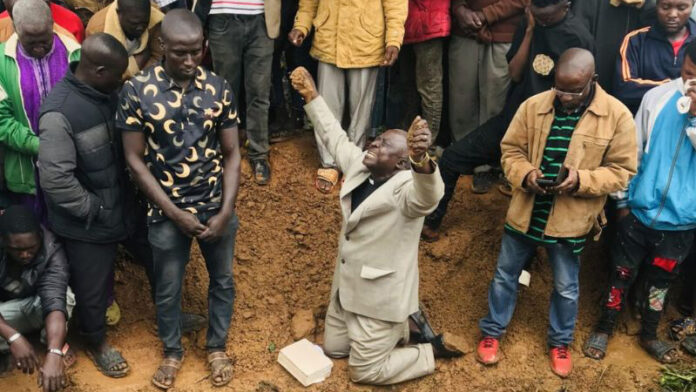
A viral video of remarks by a Reformed pastor at a mass burial of victims of Islamist violence in Nigeria’s Middle Belt has stirred up a wide-ranging debate about free speech in Africa’s most populous nation.
Some accuse the Rev. Ezekiel Dachomo, a regional chairman in the Church of Christ in Nations denomination, of anti-Islamist hate speech, while others say he is giving voice to the exasperation felt by many amid seemingly uncontrollable violence across the region.
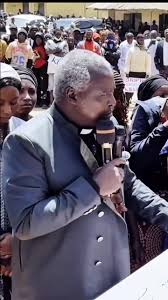
Preaching on March 4 at the mass burial of 12 Christians slain by Fulani militants in Heipang and Fan Districts, Barkin Ladi County, in Plateau State, Dachomo spoke words of defiance.
“We refuse to be Islamic,” he said. “We will never bow down to Allah. Allah is a demon. That is why when Allah wants to suck blood. He tells his members to chant ‘Allahu Akbar’ before they embark on killings, so that Allah will suck blood.”
Mentioning a nearby Muslim village and citing Matthew 5:13, Dachomo added: “We have never visited Ruga, and we will never. Because our faith in Jesus doesn’t give us the power to go and kill. But our faith in Christ gives us the power to preserve, to do the work of the salt.”
The remarks are the latest in a series of controversial statements made by the pastor, who says he has buried more than 200 people killed by Islamists in the region. He says he has received numerous death threats and offers of asylum from several nations, but is committed to remaining with his people.
The Living Church spoke with Dachomo, who says he stands by his remarks and denies any hatred of Muslims.
“In March 2008, they came to my village chanting ‘Allahu Akbar.’ They butchered my grandmother, removed her heart, removed the tongue of my uncle. I still live with that trauma,” he said.
“My simple advice is that they should stop ridiculing and dragging the name of Allah in their evil deeds of killing innocent people. I am trying to correct them to stop insulting Allah. In fact, they are the ones that are dragging Allah’s name in the mud, and certainly not me. They are making Allah look like a bloodsucker. It is only in occultic practice that you chant, kill, and spill blood.
“I have to help my Muslim brothers to weed out these evil people that are destroying Islam by using the name of Allah to kill.”
Dachomo also said he has extended help to many Muslims in his region.
“During a riot in 2008, where many houses were burnt and 13 souls lost, I saved 35 Muslims in my house in Bukuru, near Jos. Both Christians and Muslims were eating in my house,” he said.
He added that last year he contributed funds to help a Fulani man from his community make a pilgrimage to Mecca and that he allows Muslims to conduct daily prayers in his church. Relief supplies, he said, are distributed to all in need, irrespective of religion.
“As I speak, many people are converting to Christianity because we show them love,” he said.
“I am not saying that Muslims are bad people. All I am saying is that these Fulani killers have identity and they should be called to order.”
An Anglican priest from Plateau State, who asked to remain anonymous, told TLC he understands why Dachomo uses such strong language.
“It is a frustrating environment, Rev. Ezekiel is frustrated, the Christian communities are frustrated. Literally, there is no day that a village somewhere on the Plateau—a Christian community, a Christian village—is not being attacked,” he said.
“You are tempted to begin to resort to self-help but, in the attempt to resort to self-help, some of these security people will come and apprehend you and they would turn it against you and say, ‘Oh, some people were caught with weapons.’ But the Fulani militia brandish their AK-47s—there are videos of them showing off their sophisticated weapons at wedding ceremonies and no security operative dare arrest them.”
But former Senator Shehu Sani, a Muslim from northern Nigeria, suggested that Dachomo’s remarks were unchristian, writing on X that “what he said is inflammatory, provocative, and inconsistent with the teachings of the faith he professes. Inciting statements crosses the lines of decency and peace in a religiously sensitive and fragile society like ours. Everyone is entitled to defend, promote, and project his beliefs or faith but not to defame that of others.”
The Supreme Council for Sharia in Nigeria, an influential Muslim group, also harshly criticized Dachomo’s statement. Its secretary general, Nafiu Baba Ahmad, said that “Such reckless utterances are not only irresponsible but potentially dangerous, as they risk inflaming passions and sowing distrust among communities that have lived together peacefully for generations.”
The council called on law-enforcement agencies to investigate the situation: “It must be clearly stated that any individual, Muslim or Christian, who engages in reckless incitement, hate speech, or deliberate attempts to provoke religious hostility must be held accountable.”
The statement added: “Nigeria stands at a critical moment. The preservation of peace and stability requires responsible speech, moral leadership, and firm action against those who deliberately incite hatred, division, or violence.”
The council framed Dachomo’s remarks as hate speech, not blasphemy, because Nigeria’s constitution specifically refuses to condemn blasphemy (1999 Constitution 10:39).
Nigeria’s criminal code, however, defines “insult to religion” as a serious offense: “Any person who does an act which any class of persons consider as a public insult on their religion, with the intention that they should consider the act such an insult, and any person who does an unlawful act with the knowledge that any class of persons will consider it such an insult, is guilty of a misdemeanor, and is liable to imprisonment for two years.”
In 12 states in central and northern Nigeria (Kano, Bauchi, Sokoto, Zamfara, Katsina, Borno, Jigawa, Kebbi, Yobe, Kaduna, Niger, and Gombe), Islamic Sharia law has been imposed. There, laws against speech or actions that show contempt for a deity or a sacred object are on the books, with penalties including execution.
Because Dachomo made his remarks in Plateau State, which does not acknowledge Sharia law, he is protected from such penalties. But if he had spoken out a hundred miles farther north, his case could be handled very differently.
Dr. Sam Amadi, director of the Abuja School of Social and Political Thought, drew attention to this on X: “There is no blasphemy under Nigerian constitution and there can be none in a democracy with a guaranteed right of free speech. That is why the Sharia criminal law is unconstitutional.”
In a recent article in Financial Nigeria, he added, “Enacting criminal sharia undermines Nigeria’s constitutional democracy. By elevating the religious beliefs of a section of Nigerians into statutory crimes prosecuted by the state with public resources, the various state legislative houses have declared their states Islamic states and converted other citizens of the states who are not Muslims into second-class citizens. This violates the constitutional prohibition against the establishment of a state religion.”

K.C. Nwajei is a freelance journalist based in Nigeria.
