


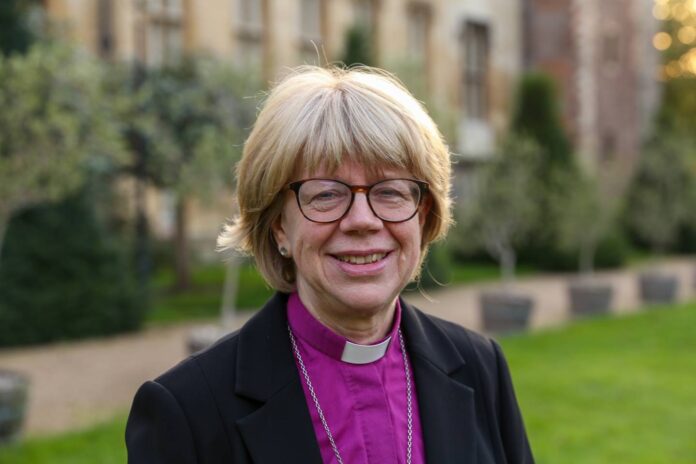
The Rt. Rev. and Rt. Hon. Dame Sarah Mullally, Bishop of London, has been chosen as the 106th Archbishop of Canterbury, the first woman to serve in the office, which dates to the arrival of St. Augustine in Kent in 597. The Archbishop of Canterbury is primate or chief bishop of the Church of England, and the spiritual leader of the Anglican Communion.
Downing Street confirmed on October 3 that her nomination by the 20-member Crown Nominations Commission had been approved by King Charles III. The commission, which for the first time included representatives from the five regions of the Anglican Communion, met last week, and at least two-thirds of the members approved of her election.
She will take office on January 28, 2026, when her ceremonial election by the canons of Canterbury Cathedral will be confirmed at a service at St. Paul’s Cathedral in London. She will be formally installed on the Throne of St. Augustine at a service in Canterbury Cathedral next March.
Mullally has served as Bishop of London since 2018, and was previously Bishop of Crediton, a suffragan see in the mostly rural Diocese of Exeter, for three years. She was among the first women to be consecrated bishop after the Church of England’s 2014 decision in favor of consecrating women as bishops, and she was the first woman to lead an ordination service in the church.
In a public statement, Mullally said: “As I respond to the call of Christ to this new ministry, I do so in the same spirit of service to God and to others that has motivated me since I first came to faith as a teenager.
“I want, very simply, to encourage the Church to continue to grow in confidence in the Gospel, to speak of the love that we find in Jesus Christ and for it to shape our actions.
“And I look forward to sharing this journey of faith with the millions of people serving God and their communities in parishes all over the country and across the global Anglican Communion.
“I know this is a huge responsibility, but I approach it with a sense of peace and trust in God to carry me as He always has.”
‘A Safe Pair of Hands’
“We have had a rocky path, and many were hoping for a safe pair of hands who can provide stability,” said Tom Middleton, the director of Forward in Faith, who wrote an article for TLC about possible candidates for the post.
“She is known in the church as pragmatic, prone to compromise and seeking a way forward amid disagreement. She’s also administratively adept and is comfortable around process. She’s not going to do anything rash or inappropriate,” he added.
“She’s not strongly identified with any particular party in the church,” said Andrew Goddard, tutor in ethics at Ridley Hall Cambridge and a prominent commentator on the Church of England.
He said that she was converted and was involved in a traditional evangelical congregation as a young woman, but might be best characterized today as “broad church or central Anglican,” a private person who is slow to share her views. “She desires to work with and bring on board people with a range of views,” he added.
Such skills and perspective could be very valuable at a time when the Church of England faces what some have called a “crisis of mistrust” over its mishandling of sexual abuse allegations, which led to the resignation of Mullally’s predecessor, Justin Welby. It is also deeply divided over the decision of the church’s bishops in 2023 to permit same-sex blessings.
Mullally has been a leader in both areas. In 2016, she led the implementation of a series of changes to the church’s safeguarding procedures that were recommended by Ian Elliott, an independent reviewer. She has also been a public advocate for the victims of abuse.
In an address at Canterbury Cathedral shortly after the announcement of her appointment she said that the church’s safeguarding failures have “left a legacy of deep harm and mistrust,” adding that “we must all be willing to have light shone on our actions, regardless of our role in the Church.”
After the 2020 publication of Living in Love and Faith, a series of teaching resources about human sexuality and Christian faith, she led a “Next Steps Group” of bishops for the next three years. The group guided the church’s discernment and implemented a series of changes, including a proposal to allow clergy to bless same-sex unions within the context of regular church services, which was narrowly endorsed by the church’s General Synod in November 2023.
Conservatives expressed concern that the group she led pushed ahead without thoroughly vetting the theological basis of the proposals, a process since taken up by the House of Bishops’ Faith and Order Commission. The commission is expected to issue a final report in the November. Since Mullally stepped down from leading the process, it has largely stalled.
At the time, she called the blessing services “a moment of hope for the Church.” But she has also said she is opposed to changing the Church of England’s traditional doctrine of marriage. Unlike some other bishops who were expected to be contenders for the primacy, Mullally has not spoken publicly about whether she supports “next steps” supported by liberals, like allowing clergy to enter same-sex marriages and authorizing “standalone” or “bespoke” services of blessings that look more like weddings.
She will likely play a major role in next week’s meeting of the church’s House of Bishops, which will receive a report from the Faith and Order Commission about doctrinal issues related to the proposed “next steps” and determine what specific proposals will be brought to General Synod in February.
Goddard told TLC that her close association with Prayers of Love of Faith makes her appointment troubling to many evangelicals in the Church of England. “There is a sense of uncertainty and trepidation,” he said, “but everyone knows we could have had a lot worse.”
Goddard, who serves in a diocesan parish in central London, said that she had a positive relationship with most evangelical parishes in the diocese, and has chosen conservative evangelicals and Anglo-Catholics for significant leadership positions.
Three of the six General Synod-elected members of the Crown Nominations Commission that chose her, he observed, were evangelicals from the Diocese of London, so “this perspective was clearly being heard.” Shortly after her selection was announced, Mullally declared that Bishop Emma Ineson of Kensington, an evangelical with traditional views on human sexuality, would become Acting Bishop of London.
“She is someone who seeks to understand and respect a variety of different traditions, and tries to hold them together. … She is known to be someone who listens and wants to hear and discern, instead of having their own views and then being unhappy when people have a different perspective,” Goddard said.
She has been among the Lords Spiritual in the House of Lords since 2018, and spoke out strongly in June against liberalizing changes to England’s abortion laws and proposals to legalize assisted dying. “Every person is of immeasurable and irreducible value, and should be able to access the care and support that they need—a principle that I know is shared by those of all faiths and none,” she said.
As Bishop of London, she oversaw a modernization of the diocese’s administrative structures, drawing on her experience in the National Health Service. Goddard said that like her predecessor, she is known as “a manager, a process person,” and Middleton said that her credentials in leading projects at a national level in church and public service likely made her a very attractive candidate.
Middleton said she has also cultivated warm relationships with the diocese’s large number of traditionalist Anglo-Catholic parishes, facing squarely the challenge presented at the beginning of her episcopate in London, whose synod was one of only a few that had voted against allowing women bishops.
“I am very respectful of those who, for theological reasons, cannot accept my role as a priest or a bishop. My belief is that Church diversity throughout London should flourish and grow; everybody should be able to find a spiritual home,” she said shortly before becoming London’s bishop.
The Rt. Rev. Jonathan Baker, Bishop of Fulham, who ministers to Anglo-Catholic traditionalists in Greater London, said that she “has always shown the greatest respect for the different theological traditions which coexist within the Church of England. In London in particular, she has generously supported my ministry and enabled the flourishing of traditional Catholic parishes and clergy across the Diocese.”
In contrast to her predecessor, Mullally has very limited international experience, and has always lived and worked in southern England. The Diocese of London, though, is among the Church of England’s most ethnically and culturally diverse, and the bishop’s role involves significant ecumenical cooperation.
Background and Training
Mullally grew up in a churchgoing family in suburban Woking, in Surrey. Her first career was as a nurse in Britain’s National Health Service, which she has described as “an opportunity to reflect the love of God.”
After graduating from what is now London South Bank University, she worked in cancer wards and became Chief Nursing Officer for England at just 37, the youngest person to ever hold the role. She was made a Dame Commander of the Order of the British Empire in 2005 for her services to nursing and midwifery.
She trained for ordained ministry in a non-residential program, which is now called the St. Augustine’s College of Theology, and she studied theology at the University of Kent. After her ordination in 2001, she served in non-stipendiary roles while continuing her career as a nurse for several years. She later became a team rector in London and a canon of Salisbury Cathedral.
Mullally will be only the second Archbishop of Canterbury since the Middle Ages to have a degree from neither Oxford nor Cambridge, bearing out the hopes expressed by Lord Evans of Weardale, chair of the Crown Nominations Commission, who told The Times in July that he aimed to avoid a shortlist in which are contenders are “white, Oxbridge, male, and come from the southeast of England.”
At 63, she is the oldest person to be appointed to the role since Donald Coggan, who graciously accepted the label “caretaker,” became archbishop in 1974, at 65. This may explain why Mullally was not included in some lists of potential contenders for the role. The mandatory retirement age for bishops in the Church of England is 70, so hers will likely be a relatively short tenure by modern standards, and it’s unlikely that she would chair a Lambeth Conference.
She is married to Eamonn Mullally, and they have a daughter and a son.
‘A Wise and Steady Leader’
Many church leaders have warmly welcomed the news of Mullally’s selection.
Presiding Bishop Sean Rowe said that he looks forward to working with her in her ministry across the Anglican Communion and added, “Bishop Sarah is known in the Church of England as a wise and steady leader, a faithful advocate for the leadership of women in the church, and a bishop who will be committed to safeguarding vulnerable people and victims of abuse.”
“I welcome and commend the nomination of Bishop Sarah as the next Archbishop of Canterbury and invite the churches of the global Anglican Communion to pray for her as she prepares to take up this important ministry,” said the Anglican Communion’s Secretary General, Bishop Anthony Poggo.
“May God grant her wisdom and discernment, as she seeks to listen to member churches, encourage mutual support, and foster unity.
“The Anglican Communion Office is fully committed to supporting her ministry as she works with other Provinces and the Instruments of the Anglican Communion.
“Let us pray that God will pour out His Spirit on the Anglican Communion to boldly share Christ’s transformational love and the hope of the Gospel in today’s world.”
Mullally’s selection was harshly condemned by GAFCON, a network of conservative, mostly Global South Anglicans, which has increasingly distanced itself from the Canterbury-based Instruments of Communion in recent years, claiming a mandate to “reset the Anglican Communion back on its biblical foundations.”
Archbishop Laurent Mbanda of Rwanda, the chairman of its primates council, wrote, “Though there are some who will welcome the decision to appoint Bishop Mullally as the first female Archbishop of Canterbury, the majority of the Anglican Communion still believes that the Bible requires a male-only episcopacy. Therefore, her appointment will make it impossible for the Archbishop of Canterbury to serve as a focus of unity within the Communion.”
Twenty-three of the Anglican Communion’s 42 member churches have approved the consecration of women as bishops, and in 17 of these churches, women serve as bishops. Only three or four Anglican churches do not ordain women to any order of ministry.
Mbanda also described Mullally’s support for blessing same-sex relationships as a betrayal of her consecration vow to “banish and drive away all strange and erroneous doctrine contrary to God’s Word.”
“Today’s appointment makes it clearer than ever before that Canterbury has relinquished its authority to lead. The reset of our beloved Communion is now uniquely in the hands of GAFCON, and we are ready to take the lead,” Mbanda wrote.
‘An Impossible Task’
Mullally will undertake a complex and demanding set of roles, described by her predecessor as “an impossible task.” Her widely admired prowess as an administrator and her past experience juggling work as a nurse and a parish priest will likely serve her well.
The Archbishop of Canterbury is first a diocesan bishop, with spiritual oversight of a small diocese in southeastern England, though leadership is largely delegated to the Bishop of Dover, Rose Hudson-Wilkin. Archbishop Welby estimated in 2015 that diocesan work consumed only about 5 percent of his time.
The majority of her responsibility will be focused on leadership of the Church of England, which is why the archbishop’s primary residence has been Lambeth Palace, on the South Bank of the Thames in London, since the 1200s.
The archbishop is Primate of All England and metropolitan of the 30 dioceses in the Province of Canterbury, where she will have a significant role in selecting new bishops. With the Archbishop of York, she will chair the Church of England’s main decision-making bodies, the General Synod and the Archbishops’ Council.
Given the archbishopric’s antiquity (the office is about 300 years older than the monarchy and about 700 years older than Parliament), Mullally will inherit a number of state roles. In addition to her membership in the House of Lords, she will serve as a member of the Privy Council (a role she has already filled as Bishop of London since 2018), and will preside at numerous state ceremonies. In England and Wales, the archbishop is first in precedence after the Royal Family (the prime minister is fifth).
The archbishop plays a central role in the life of the Anglican Communion, convening the Lambeth Conference, and serving as chair of the Anglican Consultative Council and the Primates Meeting. In a 2015 review, former archbishop Justin Welby estimated that he spent about 25 percent of his time on Anglican Communion matters.
The Nairobi-Cairo Proposals, a set of changes to the Anglican Communion’s structures developed by the Inter-Anglican Standing Commission on Unity, Faith, and Order, outlines a potential decentering of the archbishop’s role in the Communion “as a means of persevering together amid division.”
In addition to revising the Communion’s classic definition, they would create a rotating presidency for the Anglican Consultative Council and give the Primates Standing Committee more responsibility for convening the Primates Meeting and the Lambeth Conference. Responsibility for serving as “the ‘face’ of the Communion’s 42 sister churches,” representing worldwide Anglicanism in ecumenical and ceremonial contexts, would be shared between the Archbishop of Canterbury, the President of the Anglican Consultative Council, and the Secretary General of the Anglican Communion.
The Archbishop of Canterbury would remain one of the four Instruments of Communion in the plan outlined by the proposals, but the changes would enable more emphasis to be placed on her “personal and pastoral” ministry, and would allow the archbishop “to serve, encourage, and persuade, as a brother or sister among siblings and peers, particularly in the college of the Lambeth Conference and the Primates’ Meeting.”
Former Archbishop Justin Welby was a strong advocate of such changes, which he said would make the archbishop’s role more manageable. At the Anglican Consultative Council’s 2023 meeting in Ghana, he said, “The role of the Archbishop of Canterbury, the See of Canterbury, is a historic one. The instruments must change with the times.”
The proposals are set to be considered for adoption at the June 2026 meeting of the Anglican Consultative Council in Northern Ireland, which Archbishop Mullally will chair.

The Rev. Mark Michael is editor-in-chief of The Living Church. An Episcopal priest, he has reported widely on global Anglicanism, and writes about church history, liturgy, and pastoral ministry.
