


The Noble Army
The Modern Martyrs of Westminster Abbey
Edited by James Hawkey
Haus Curiosities, 111 pages, $17.95
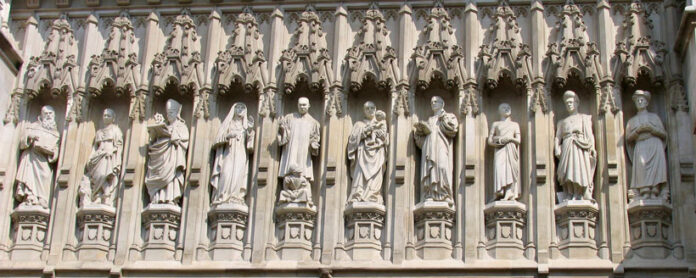
 In July 1998, ten statues of martyrs of the 20th century surmounting the Great West Door of Westminster Abbey were unveiled. The statues were intended to represent the millions of individuals who suffered and died for their faith in Christ in a century that many have considered as the most violent in human history.
Those who believe that martyrdom occurred centuries ago and far away, ostensibly in the Middle Ages, long before the light of reason and religious tolerance shone upon and transformed bestial human nature, are recommended to this collection of 10 deeply moving essays (each introduced by a black-and-white photo of the subject’s statue), which had begun as sermons in a series preached in Westminster Abbey by the Dean and Chapter during the autumn of 2023, to mark the 25th anniversary of the statues’ installation.
The call to martyrdom is a call to witness, and the essays that reflect on the lives of these 20th-century men and women, from different continents and different churches, underscore the understanding that martyrs bear witness in their contexts and circumstances: victims of Nazi and Bolshevik oppression, state-sponsored violence, and religious hatred. The Noble Army also explores the questions surrounding the choices these individuals made, as well as the contemporary reality of Christian marginalization and persecution.
Selecting which individuals would be represented and where they would be placed on the abbey’s façade took time. In addition to compiling a list of potential “candidates” (in October 1993), the next three years were devoted to careful ethical, theological, interfaith, and artistic considerations.
It is the stories of these extraordinary people, three of whom are discussed here, and most of whose lives began and ended far from the grand edifice that now shows their immortalized likenesses, that speak of the depth and breadth of their faith.
Manche Masemola, youngest of these modern martyrs, was a member of the Pedi ethnic group in Northern Transvaal (now part of modern-day South Africa), where she died in 1928. To her family and community, her conversion and allegiance to Christianity stood as disruptive defiance and disloyalty, and she spoke of being “baptized in her own blood,” which was a “better baptism.”
Masemola’s poignant story, sensitively written by David Hoyle, tells us that we must be honest about her “otherness,” which derives from her place and time that are so different from ours, and about her “bright, brittle courage,” tested in ways that are unfamiliar to us. Masemola’s strangeness reflects that of the saints, which we so often try to manage or to remove outright.
Anthony Ball’s essay on Uganda’s Archbishop Janani Luwum tells that in both his words and deeds, Luwum was an “uncompromising witness” for what he considered God’s justice and love, which he courageously expressed against the corruption and violence of Uganda’s third president, Idi Amin. Ball’s riveting account describes the brutality of Amin’s military coup in 1971, followed in 1972 by the expulsion of around 80,000 South Asians from Uganda (with only 90 days’ notice), and of the extrajudicial killings of between 80,000 and 500,000 people, including Luwum.
His outspokenness against Amin’s despotism increased, and he would continue to exercise a ministry directed to all people, calling on Ugandans to live peaceably and in harmony, while at the same time personally interceding against Amin’s excesses and abuses of authority, ultimately leading to Luwum’s martyrdom. For him, the words of Psalm 119:158 spoke forcefully: “It grieveth me when I see the transgressors; because they keep not thy law.”
James Hawkey writes movingly of Elizabeth of Russia, who chose to convert to Orthodoxy. She was grandaughter of Queen Victoria and great-great-aunt of England’s King Charles III. Her life was lived in “two halves,” first as a sought-after court beauty, whose husband had been assassinated, and later as a religious superior and committed witness to God’s love in Christ through work among the poor and disabled.
Relieved of her various charitable responsibilities, Elizabeth was arrested the day after Tsar Nicholas II and his family were murdered, and she and her sister were martyred. To the end, Elizabeth extended forgiveness to her murderers, which stood as an example of creating new possibilities and of bearing witness to redemption.
In his homily “God Will Wipe Away Every Tear,” delivered on November 1, 2023, and which is a special 11th reflection in the book, the Rev. Bashar Warda writes about Ragheed Ganni, an engineer from Iraq who had answered the call of God and was ordained. Though 2003-04 brought encroaching danger and violence to Mosul, Ganni persevered in his faith, choosing to obey God’s call by openly celebrating the Mass and by organizing Christian education activities and youth gatherings. Like Jesus, Ragheed Ganni knew what was heading toward him, and he met it fearlessly.
As Fr. Warda sees it, we, like Ragheed Ganni, should be prepared to give our bodies to Christ, the head of the Church; such was the choice these and other martyrs made in their witness to the Godhead. Their faith was brave and startling, a lamp unto our feet, and the highest examples of the Lord’s blessings. We should read their stories and be inspired by their brave and startling faith.

Pamela A. Lewis is a member of Saint Thomas Church, Fifth Avenue, in New York City. She writes on topics of faith.
