


Eyewitness
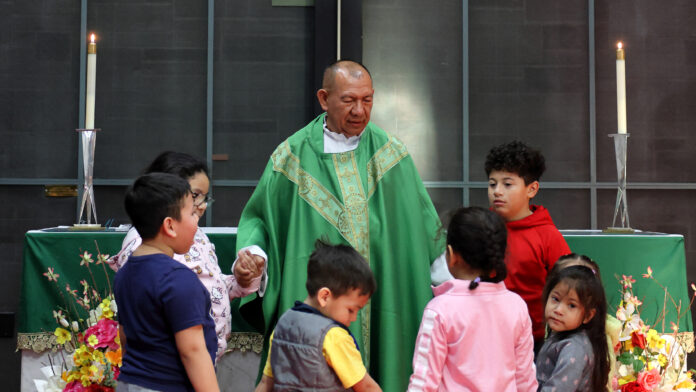
It is another Sunday at San Mateo Episcopal Church in Hyattsville, Maryland. The children turn their small faces upward and their eyes shine with hope. They lift their hands to receive the host, the Body of Christ, believing the promise: they will be cared for in this place. With this act the congregation of San Mateo declares that all Christians belong to one another.
San Mateo is a thriving parish. It offers four Eucharists on a Sunday. Three are in Spanish and one in English, plus a Saturday evening service, recorded for broadcast. The church and hall are thrumming with activity every day of the week. The congregation counts more than 500 members. Padre Vidal Rivas, a U.S. citizen born in El Salvador, has shepherded San Mateo since 2011, building it up from a shrinking English-only congregation to a busy multilingual and multigenerational community.
In 2025 the anti-migrant rhetoric and then swift deportation actions of the Trump administration have devastated the congregation. At San Mateo this is not happening on the small screen but in real life. San Mateo is packed with survivors and frightened immigrants.
“Eight congregation members have been kidnapped—taken from the streets, or their homes,” Padre Vidal says. “Held in isolation, in freezing rooms. With very little food, hardly any water. And then just gone. We don’t know where. My people are innocent of crimes. They are working men and women, cleaners and hospital employees. Farms and factories.” He shakes his head.
He can’t believe his ministry has turned into this. He escaped the devastating civil war in El Salvador, and now he witnesses another type of war. Padre Vidal and San Mateo are on the front lines, caring for immigrants, strategizing how to keep his people safe, organizing with neighbors, Episcopalians, and others.
“I spend every day thinking, how can I stand up and be strong when those around me are terrified? About 80 have just left and gone back home,” he says. “The choir leader, the lady in the kitchen, two workers in the daycare. Mothers have been left with children and no way to pay the rent. Victims of human trafficking, who have no resources at all, arrive on our doorstep.”
Padre Vidal, and his wife, Angelita; Deacon Sally; and other members of the congregation are pressing on through the fear, building the kingdom here and now. Living day by day, listening, waiting, making pupusas, distributing food, fixing the furnace, finding a way to transport a disabled girl to school because her mother is too afraid to go out.
On the night before, San Mateo celebrated a vigil before the Feast of Christ the King. Lay people have written reflections. One after another, they read and offer their faith to all: What it has meant to follow the King, the Prince of Peace. Satisfaction, belonging, joy. The hymns are lovely, the choir all dressed in red.
The next day is the last Sunday of the church year. There are the usual 30 people for the 10 a.m. Eucharist (in English). For the noon Eucharist there are several hundred parishioners, but that is down by at least a quarter.
“People are afraid, afraid to come to church,” Padre Vidal says. “They watch online. Or they are just gone, without saying anything.”
English-speaking neighbors come and stand before the locked doors. They patrol the parking lot.
Deacon Sally accompanies me to the nave. During Holy Communion, 50 children come first. Little face after little face turns toward me: some are shy, some defiant, some hopeful. Tears burn behind my eyes and fall. I try to hide them. I was first here almost a year ago; I have been praying ever since for these beloved people.
Then come the adults. Women who have worked, caring and cleaning. Men who are in shock, and vulnerable. The service carries on. We pray for birthdays and anniversaries, for hopes emerging, for fears unfolding. We say goodbye to some who are returning to old homes this week. We pray for those who have disappeared. We hear about the posadas this year: all will take place in the sanctuary of the church buildings.) Then we move to a feast in the hall.
In the evening, I get sick. Cough, cold, stuffy, headache. I sleep for days in my borrowed bed in the rectory. The women of San Mateo care for me. They ply me with medicine and teas. They bring me clothes for the next stage of my overland pilgrimage. I’m headed to Minnesota.
“You’re going to need this, Reverenda,” they say: hats, gloves, socks, an enormous puffy parka. After three days in my sickbed I make my way to the Amtrak station. I’m ready. But I am leaving with a shredded heart.

The Rev. Emilie Smith is Guest Writer on Covenant. She is parish priest of St. Barnabas Anglican Church, New Westminster, Canada, and TLC’s Latin America correspondent.
