


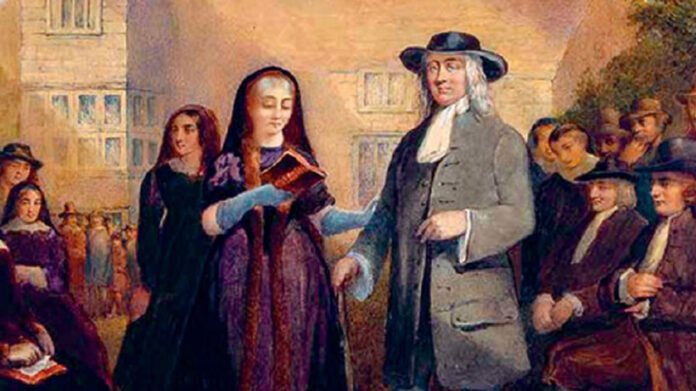
While Sarah Mullaly is the first woman to serve as the Archbishop of Canterbury, she is part of a long lineage of English female preachers that includes Margaret Fell, the cofounder of Quakerism, who wrote the first lengthy defense of women’s preaching in English in 1666. English Quakers published a modern translation of Women’s Speaking Justified in March to celebrate Mulally’s appointment.
Fell’s text starts with Genesis, which says that God created both men and women in his image. It then draws on examples of female preaching and ministry in both the Old and the New Testament, such as Judith and Mary Magdalene. The modern translation was done by Paul Anderson, a Quaker New Testament scholar, who added an introduction and commentary.
“I see this as a great ecumenical opportunity,” Anderson said. While the text has long been widely read by Quakers, it has not garnered much attention from outsiders until recently.

“We’re delighted,” said Tim Gee, general secretary of the Friends World Committee for Consultation, about Mulally’s appointment. “We hope to work together for peace.” He hopes to hand out copies of the text at the installation.
Fell’s relationship with the Church of England was less friendly. She was born in 1614 and came of age during a turbulent time, when a proliferation of Christian groups dissented from the established Church. In 1652, during the reign of Oliver Cromwell, Quaker founder George Fox visited the Fell home in Lancashire. Fell became convinced of the truth of this new expression of Christianity, which said God could reveal himself to ordinary people. Quakers, both men and women, would sit and meditate until they felt the inward light of God calling them to speak.
After the restoration of the monarchy, the state and the established church wanted to stamp out dissenting groups. The state did not want another Civil War. The Society of Friends, whose nickname of Quakers arose as a derogatory remark in reference to their fierce trembling before the authority of God, were considered particularly suspicious.
The Church of England even feared they might be secretly controlled by the Jesuits as part of their plot to overthrow the state. Fell delivered a statement of peace to Charles II in 1660. Nonetheless, in 1664 she was arrested and spent four years in jail for her beliefs. It was while in jail that she wrote Women’s Speaking Justified.
Fell was not the first woman to preach. There were Baptist prophetesses during the same period. Anne Hutchinson had been exiled from Massachusetts for her preaching. Anne Askew had been burned at the stake for being a Protestant and a preacher during the reign of Henry VIII.
Before the Reformation, Catholic priests complained about the pro-vernacular Lollard movement leading to both men and women spreading the gospel. But while women using Scripture to justify their ministry was not unique, Fell writing a long text about it was. The Society of Friends was more supportive of women’s preaching than other dissenting groups, related to Quakers’ very strong sense of the priesthood of all believers.
Fell emphasized to her fellow Protestants that opposition to women’s ministry comes from Catholics. “The Pope is the Head of the False Church, and the False Church is the Pope’s Wife: And so he and they that be of him, and come from him, are against Women’s speaking in the True Church,” she wrote. Most English people at the time did not agree.
But by the 19th century, there were many other Protestant denominations in England that recognized female preachers. This was not the case in the Church of England. An 1880 Church of England defense of deaconesses said they were needed for teaching, nursing, and visiting the poor, not for preaching. But this too would change, leading to the ordination of women as priests in the 20th century and bishops in the 21st century in the Church of England—and now, too, as Archbishop of Canterbury.

Greta Gaffin is a freelance writer based in Boston. She has a master of theological studies degree from Boston University and a bachelor’s degree in economics from the University of Massachusetts Amherst.
