


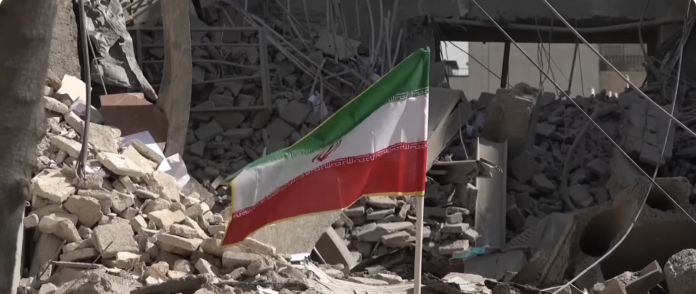
America’s war with Iran brought mixed sentiments for Christians of Iranian descent, including an Episcopal priest who fled the country in the late 1980s. Early on the morning of February 28, President Donald Trump confirmed that the United States had launched a wave of airstrikes against the Middle Eastern country. It joining Israel, which had launched attacks earlier.
Hours later, Trump announced that Ayatollah Ali Khamenei, the supreme leader of the Islamic regime, had been killed in the attacks. A hardline Islamist who rose to power after the 1979 Iranian Revolution, Khamenei and the Islamic Revolutionary Guard Corps were responsible for killing thousands of activists and persecuting Christians in the country.
“We were all in shock,” said the Rev. Canon Dr. Samira Page, who leads the Farsi-speaking congregation Grace Community Church in the Diocese of Dallas. Page, along with her former husband and children, fled the country amid religious persecution in 1989, eventually finding refuge in Dallas after a perilous journey through Turkey and Mexico. Khamenei’s death, she said, “was a moment that we couldn’t have imagined.”
She said parishioners were practically ready to celebrate on March 1, a Sunday, but she added that it wasn’t the proper response. She described Khamenei’s death as a significant moment in history but said a Christian response involves moderating “that sense of joy and remember[ing] that the Lord does not take pleasure in the death of the wicked.”
“We needed to continue to pray for Iran and to pray for protection of the people, and for the protection of the U.S. troops … and for the war not to spread throughout the region,” Page told The Living Church.
The second week of the operations in the Middle East has claimed the lives of seven American service members and cost taxpayers $5.6 billion. According to the Iranian Red Crescent Society, more than 1,200 people have been killed in Iran, and casualties are mounting in other parts of the region as Iran retaliates against the attacks. In Lebanon, 486 people have been killed, including a Maronite Catholic priest in the country’s southern region. In Israel, 11 people have been killed, including two soldiers and four minors.
On March 9, the embattled Islamic regime named 56-year-old Mojtaba Khamenei as the country’s new supreme leader. He is the son of the late Ayatollah Khamenei and is expected to maintain his father’s hardline approach toward the U.S. and Israel.
Page said the possible overthrow and drying up of the “roots of evil” that had blanketed Iran for decades is not the ultimate solution. “We know that peace and justice only come through Christ,” she said.
She said the church is tasked with working toward justice and peace, and her prayer is for the “will of the people to prevail and that God would illuminate their hearts to will what is good.” She recognizes the emotions many feel, and the longing to see the government overthrown, but she expresses concern about the challenge of what may come next.
“Who knows what’s going to happen tomorrow? We don’t know. The future is uncertain and there are no easy answers,” Page said.
Lana Silk, who heads the Christian nonprofit Transform Iran, said people should bear in mind that the vast majority of Iranians in the diaspora have family in the country. “There’s been a lot of worry and concern for the well-being of their family and the hope and the dream that their family will be safe again,” she said. She also described the strain brought by the country’s struggling economy.
“Our families have been struggling to get access to enough food. There’s concerns over getting the medical care they need. They can’t afford to pay their rent. … It’s hard for us watching from outside, where we can’t really do much about it,” Silk added, because it is not easy to send funds to the country.
Due to U.S. sanctions against Iran, all fund transfers to the country are prohibited unless licensed by the Treasury Department’s Office of Foreign Assets Control.
Both Page and Silk expressed hope for what is to come while urging Christians to continue praying for the country. “My prayer is firstly for God’s mercy, his mercy in protecting lives from being lost, his mercy for the suffering that’s being endured,” Silk said.
As the war progressed, Archbishop Hosam Naoum of the Anglican Province of Jerusalem and the Middle East called on the church to engage in “unceasing prayer” and to remain “bridge builders”: “Even as diplomatic windows seem to slam shut, the Church must keep the doors of reconciliation open.”
Naoum oversees the Diocese of Iran, which the Anglican nonprofit Jerusalem and the Middle East Church Association (JMECA) describes as “the most isolated in the Communion.” The jurisdiction dates to the missionary work of Henry Martyn, who is regarded as the first Protestant missionary to live in what was then called Persia. According to JMECA, there are three deacons in the country, and a few employees who handle administrative work for the diocese.
The Rev. Shahzad Gill serves as the senior chaplain to the Moderator of the Church of Pakistan, the Right Rev. Azad Marshall, who is the last bishop to have oversight in the diocese. Gill told TLC that Marshall has appealed to the Christian community in Pakistan and lit candles for peace.
“We are praying, first of all, that peace will prevail,” Gill said, “because the church’s responsibility is to always pray for fellow believers, and that is what we are doing—that peace will come, that stability will come.”
Presiding Bishop Sean Rowe, together with ecumenical and interfaith partners, led an Interfaith Vigil for Middle East Peace on March 10.

Caleb Maglaya Galaraga is The Living Church’s Episcopal Church reporter. His work has also appeared in Christianity Today, Broadview Magazine, and Presbyterian Outlook, among other publications.
