


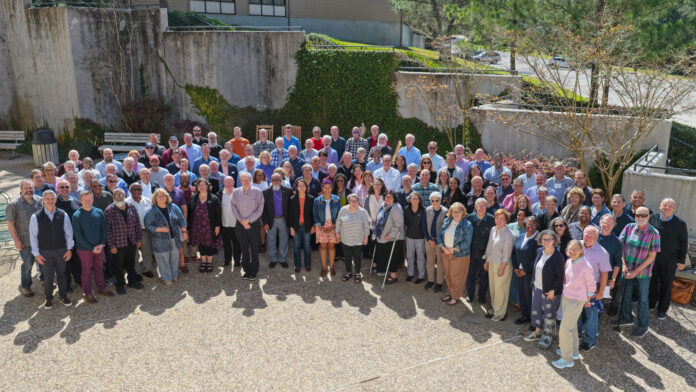
The House of Bishops invited the deans of 12 Episcopal seminaries and theological formation schools for an “unprecedented” and “unifying” three days of conversation about theological education and priestly formation during a March 18-23 spring meeting at Camp Allen in Navasota, Texas.
The 122 bishops and bishops-elect in attendance also strategized with Presiding Bishop Sean Rowe about the church’s long-term needs and discussed the Nairobi-Cairo Proposals for altering the Anglican Communion’s Instruments of Communion, as well as prayer book revision.
At a press conference on the gathering’s final day, Bishop Jennifer Baskerville-Burrows of Indianapolis, the vice president of the house, described the gathering as “a time of great high energy, and what feels like the kind of trust and relational work needed for us to help lead the church in this moment.”
She also described an “overwhelming sense that the folks who are called into this moment are the right people, and we are united in how we are moving forward to face these challenges.”
Theological Education
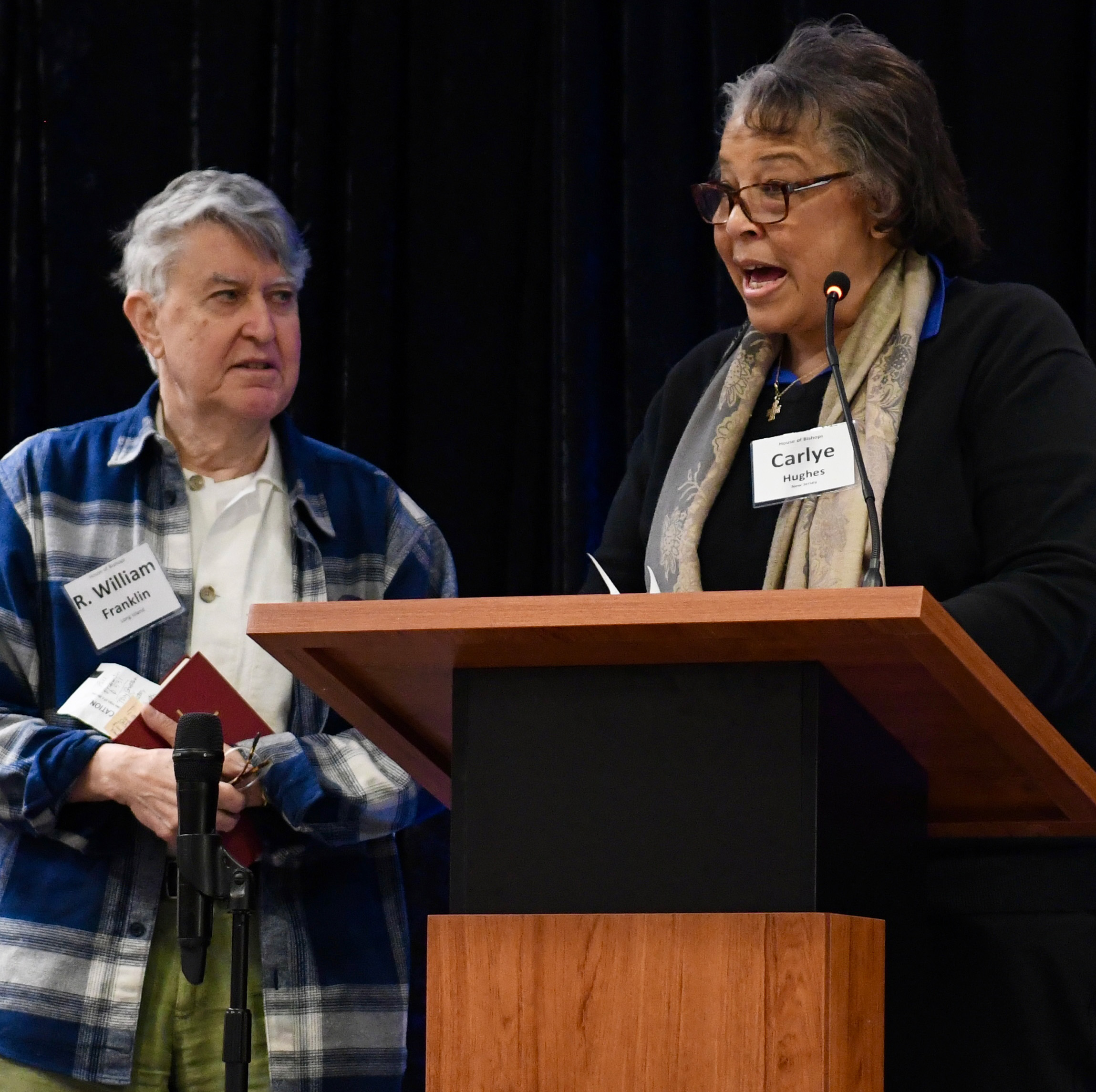
Bishops Carlye Hughes of Newark and William Franklin, an assisting bishop in the Diocese of Long Island, said that the decision to invite the seminary leaders to extended meetings with bishops emerged from conversations that began two and a half years ago, after major changes at three of the Episcopal Church’s eight seminaries related to wider shifts away from residential training and required education at Episcopal-affiliated institutions.
Within less than six months in late 2022 and early 2023, General Theological Seminary was purchased by Virginia Theological Seminary, Episcopal Divinity School parted ways with Union Theological Seminary and became non-accredited, and Church Divinity School of the Pacific shifted to all-online hybrid-distance learning.
“I think there was a surprising sense that we’re on the threshold of a new era, and the bishops and theologians worked so well together,” Franklin said, adding that devoting three days to the topic was a sign of how important priestly formation is to the bishops.
Hughes said the bishops do not plan to resist wider changes in ministerial education.
“Our approach was to say, ‘This is the world we’re in now, and how do all of these [different institutions] work together?’’’ she said.
“I don’t think we want the educators to think of themselves as being in competition with each other for our attention and all of us want to move out of a client-vendor relationship. We don’t see ourselves as consumers and they don’t see themselves as running the marketplace.”
She added: “The basic question is, What do we need to make good priests? There’s a recognition that it can happen in a number of ways, but the key thing is that we coalesce and have some agreement on what are the things we’re trying to form and develop in people.”
The Very Rev. James Turrell, vice provost and dean of the School of Theology at the University of the South, told The Living Church, “It was a very fruitful conversation, marked by an appreciation on all parts for the distinct roles of bishops, seminaries, and other formation programs in providing the church with the leaders it needs. We were able to think together about recruiting and selection processes, as well as post-ordination formation.”
He added: “As a bishop once remarked to me, bishops are in many ways the ‘end users’ of our products, and all of us in theological education want to make sure that we are meeting the needs of the church. All of us—bishops and deans alike—spend a great deal of time thinking about the kinds of ordained leaders the church needs.”
“I’m grateful for the Presiding Bishop’s prioritizing theological education, and for the warm welcome extended by the bishops throughout the gathering. The conversations were rich and substantive, marked by a genuine spirit of collaboration among seminary deans and bishops alike, as we reflected together on preparing leaders for the church across diverse contexts,” said Dr. Lauren Whitnah, dean of Nashotah House Theological Seminary.
“Different contexts call for different training models, and Nashotah House is glad to continue offering our unique model of ministry formation alongside our co-laborers in the Episcopal Church,” she added.
Participants in the meetings included the leaders of the Bishop Kemper School of Ministry, Berkeley Divinity School at Yale, Bexley Seabury Seminary, Church Divinity School of the Pacific, Iona School for Ministry, Nashotah House, the University of the South’s School of Theology, Seminario Diocesano San Pedro y San Pablo, Seminary of the Southwest, Stevenson School for Ministry, and Virginia Theological Seminary. The dean and president of Episcopal Divinity School planned to participate, but travel issues interfered.
Strategic Planning
Bishop Michael Hunn of the Rio Grande said that a strategy session convened by Presiding Bishop Rowe began with honesty about sustainability challenges being faced by many congregations, especially in rural areas, which lack full-time clergy leadership and can have difficulty finding people with qualifications to serve as church treasurers. Hunn said it would take 2,300 people to fully staff the roles required by the Title IV disciplinary process across the church’s 106 dioceses, a clear impossibility.
“I was really encouraged by the Presiding Bishop’s vision,” Hunn said. “I feel that he knows and sees and understands what life is like. He talked about how the churchwide structure needs to focus on helping dioceses that are struggling to deliver the ministry of the Episcopal Church locally.”
He said that real estate management, evangelism, communications, and clergy discipline were areas in which the Episcopal Church Center is already providing more assistance to dioceses.
“I was really excited to hear that the Presiding Bishop and the Presiding Bishop’s team are intentionally looking at a 30-year horizon and thinking about How do we strengthen the church over that period of time?—not just his nine-year-term or the next five years,” Hunn said.
“It means acknowledging the actual pressures and stresses that we’re facing with a real sense of hope. Not just that God will take care of it, but that we actually have the enthusiasm and excitement and energy if we work together to make sure our church not only continues to exist, but continues to thrive in a world that’s desperate for it,” he said.
Hunn also mentioned enthusiasm among the bishops for Bishop Rowe’s plan for “a strong evangelism effort that will get the word out in the world about who we actually are, because a lot of people have never heard of the Episcopal Church. … So that in ten years’ time if you ask the average person on the street, that person will be able to say, ‘I’ve heard of that Episcopal Church, and I think they’re about this.’
“Who we are is actually compelling and inviting the broader population; it’s just that they’ve never heard of us. And it’s been decades since we’ve actually done a real strong push about who the Episcopal Church is, so there’s a lot of energy and enthusiasm about the Presiding Bishop’s vision.”
Article X Revision
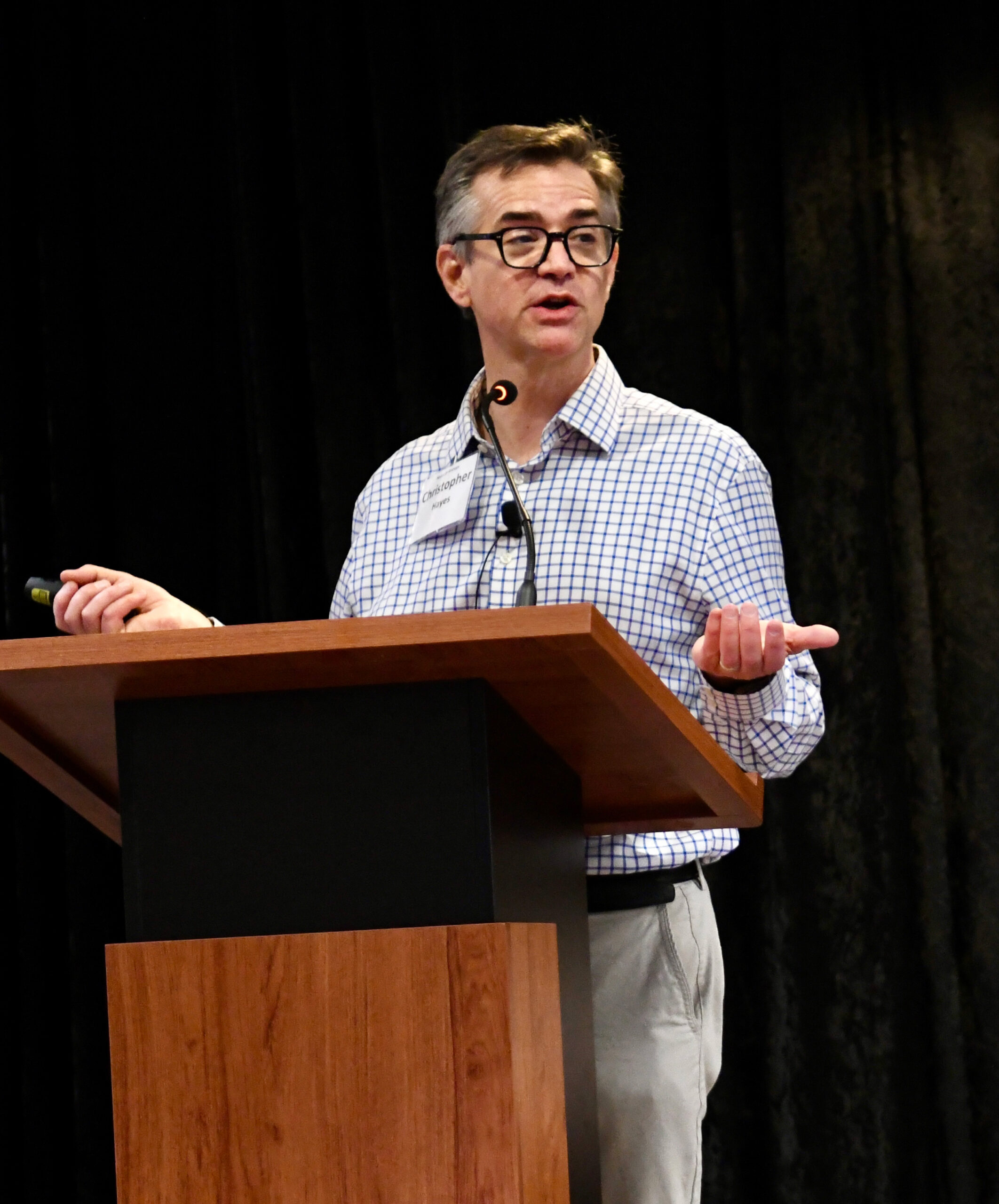
Hunn said the bishops were briefed by Christopher Hayes, the Diocese of California’s chancellor, about the progress of a working group he leads that is charged with reviewing canons related to Article X of the Episcopal Church’s constitution, which defines the Book of Common Prayer.
Prayer book revision has been a contentious topic at many recent General Conventions, and significant revisions to the article were passed at the 2022 and 2024 conventions. The 2022 revision aimed to define the prayer book more expansively, creating what some called a “prayer book in the cloud,” while a major aim of the 2024 revision was to insert language from a 2018 convention resolution that “memorialized” the 1979 Book of Common Prayer.
Clergy and congregations with a traditional understanding of marriage see this as an important protection, because it allows continued use of the current marriage rite even after the likely addition of a same-sex rite at the 2027 General Convention. It also establishes two official teachings on marriage within the Episcopal Church.
Hunn said a major part of the working group’s responsibility is to develop a system to categorize and standardize the variety of supplemental and alternative rites developed in recent decades, and to develop better guidelines for translating liturgies.
Hunn said that “there is within the church some level of confusion about what [prayer book] memorialization actually means,” suggesting that for some Episcopalians, memorializing the 1979 book means establishing it as the church’s “forever gold standard,” while for others, the intent of the language is to ensure “that the 1979 Book of Common Prayer was not just removed quickly in the way that the 1928 was, where there was a kind of move that said, ‘Well, now that we got the new one, you can’t use the old one.’
“There are a lot of people who love the 1979 Book of Common Prayer and have grown up with it,” he said. “I think part of the move behind the use of the word memorialization was really a call from the pews to say, ‘Don’t mess with the prayer book that we love,’” he said.
“I think we do need to have further churchwide conversation around the nature of not just how does a new idea make its way towards becoming part of the Book of Common Prayer, but also how do we keep what we love about the Book of Common Prayer that we have.”
Nairobi-Cairo Proposals
The Rt. Rev. Ian Douglas, a former Bishop of Connecticut who now serves as an assisting bishop in the Diocese of Massachusetts, spoke about a panel of bishops that shared perspectives on the Nairobi-Cairo Proposals, issued in 2024 by the Anglican Communion’s Inter-Anglican Standing Commission on Unity, Faith, and Order.
The proposals, to which a supplement was added earlier this month, suggest changes to a classic definition of the Anglican Communion and to the Archbishop of Canterbury’s role within the Instruments of Communion to allow for “good disagreement” at a time of deep division over human sexuality. They are due to be considered by adoption by the Anglican Consultative Council (ACC) when it meets in Belfast next summer.
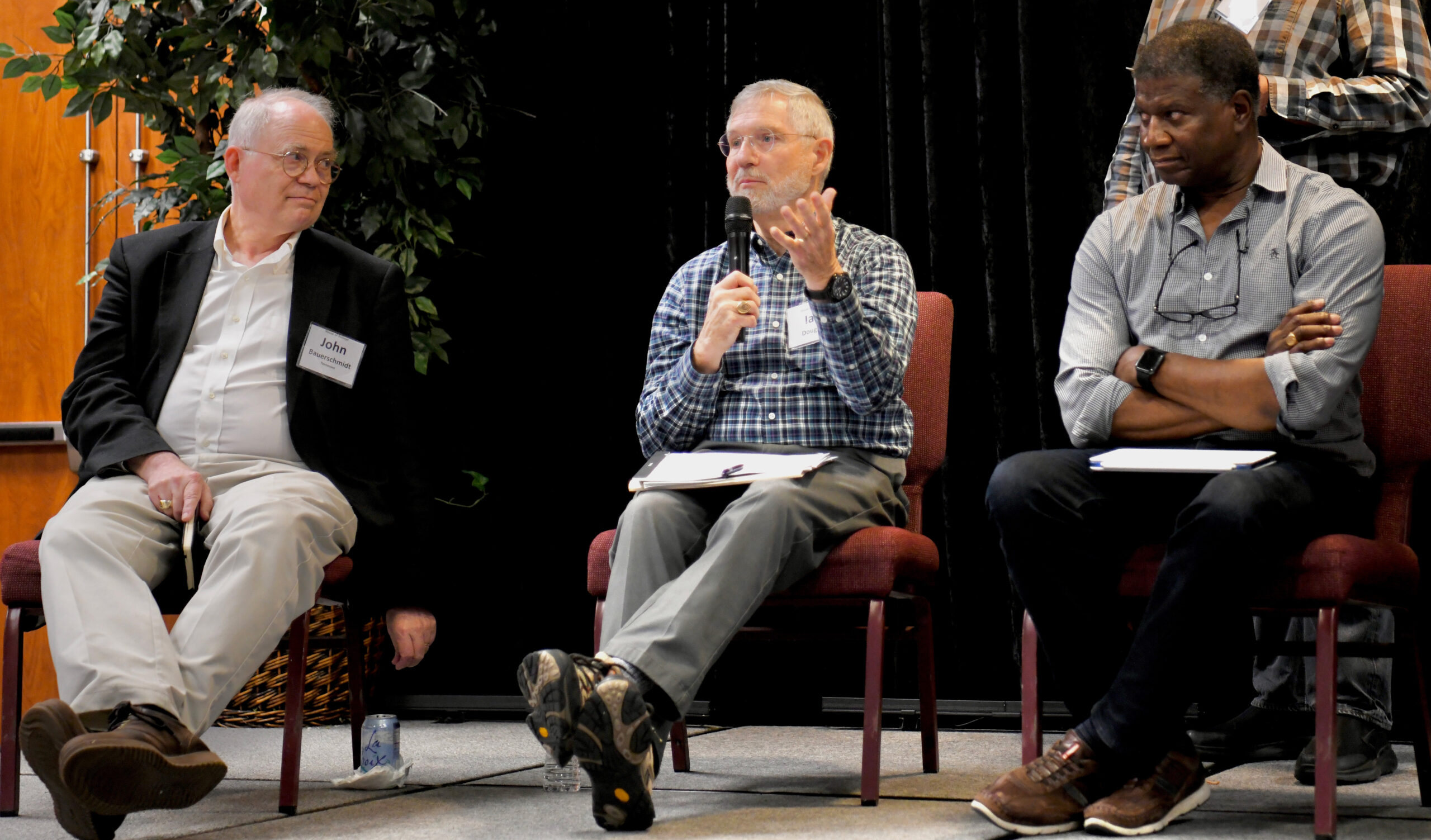
Douglas said that he and his fellow panelists—Bishop John Bauerschmidt of Tennessee and former Maryland bishop Eugene Sutton (a member of the commission who helped to draft the proposals)—all held different positions.
Douglas and Bauerschmidt were among the contributors to The Nairobi-Cairo Proposals: Voices in Response from the Episcopal Church, a 157-page collection of essays by church leaders coordinated by the House of Bishops’ Ecclesiology Committee, released March 9. Douglas said that all bishops received a copy of the text, and that the Episcopal Church had engaged more extensively with the proposals than any of the Anglican Communion’s other member churches.
Douglas said conversation about the proposals among the bishops was “robust,” but there seemed to be broad consensus that the Communion needed more time to consider such significant changes to its identity and structures.
“There’s a lot in these proposals that we would need to consider seriously. We wondered, ‘Why the rush?’ Why just 18 months, during which there was a transition in the See of Canterbury?’”
“Wouldn’t it be good to come together at ACC-19 and have a substantial discussion? But also allow and encourage ACC members to go back to their churches and also have a fuller discussion. It’s a process of reception, and reception doesn’t happen quickly,” he said.
Douglas said the bishops’ responses were communicated to Bishop Rafael Morales Maldonado of Puerto Rico, the Episcopal Church’s current bishop representative to the ACC.

The Rev. Mark Michael is editor-in-chief of The Living Church. An Episcopal priest, he has reported widely on global Anglicanism, and writes about church history, liturgy, and pastoral ministry.
