


On January 22, the National Park Service removed an exhibit, “The Dirty Business of Slavery,” from the President’s House in Philadelphia, part of Independence National Historic Park.
This display focused on the enslaved people who were part of George Washington’s household, but it also commemorated two men who were important to Philadelphia’s Black community in the 18th and 19th centuries: Bishop Richard Allen, who founded the African Methodist Episcopal Church, and the Rev. Absalom Jones, the first Black priest in the Episcopal Church. Jones’ feast day is on February 13.
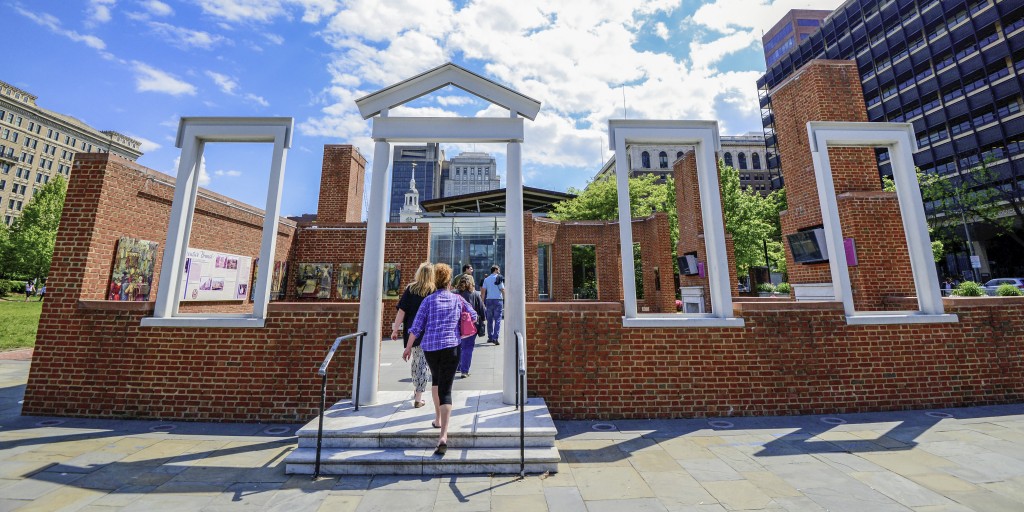
“It’s sad that the federal leadership felt they needed to do this, but this does not damage the Black history of our country. It’s not going anywhere. Changing or removing a monument does not change that– it lives,” said the Rev. Mauricio Wilson, president of the Union of Black Episcopalians and the rector of St. Paul’s Church in Oakland, California. Black Episcopalians across the United States are organizing days commemorating Jones for the next week.
Nowhere is that more important than at the African Episcopal Church of St. Thomas in Philadelphia, which Jones founded in 1794. “This year’s celebration of the feast of Absalom Jones will have different emphasis and spiritual meaning,” said its rector, the Rev. Canon Martini Shaw. While the parish normally celebrates Jones at the Sunday morning service closest to his feast day, this year it will be at 4 p.m. February 15. Former Presiding Bishop Michael Curry will preach.
St. Thomas invites members from two other local parishes to attend: Christ Church and St. Peter’s. These were the parishes that Jones attended with his slave master, before he was freed in 1784. “You can’t tell the story of freedom without telling the story of slavery as well,” Shaw said.
This is what frustrates Shaw and others about the removal of the display, which also included information about Jones and Allen’s ministry to the city during the devastating yellow fever epidemic of 1793. The National Park Service had even contacted the church for more information about Jones when they it was creating the exhibit.
But since President Donald Trump issued Executive Order 14253, “Restoring Truth and Sanity to American History,” last March, historical markers that present aspects of American history in a negative light have come down in several places.
“This whole removal is part of the bizarre paradoxicality of this American iteration of the evangelical Christian nationalist project,” said Joshua Washington, a Black Episcopalian who is a member of St. Clement’s, another Philadelphia parish.
To Washington, Allen and Jones represent a faithful Christian witness that is important in understanding the American story from a Christian perspective. He grew up in a Pentecostal church in New York City, but the church talked about Allen and Jones because of their importance to the history of the Black church in the United States.
Wilson expressed his concern that this history will only be taught at Black churches. “African American kids will know about this regardless, but non-African American kids will lose out on an important part of our history,” he said.
“I am hopeful that someone will recreate new interpretive posters for display in multiple other locations to replace the ones removed by National Park Service,” said the Rt. Rev. Dorothy Wells, the Bishop of Mississippi, who has written extensively on Black history and religion.
She acknowledged that Black worshipers being unwelcome at St. George’s Methodist Church—which led to the founding of both the AME and St. Thomas—can be an uncomfortable topic. But she doesn’t think it should be ignored.
“Both Absalom Jones and Richard Allen made history as the first two Black lay preachers in the Methodist Church (St. George’s Methodist Episcopal Church, Philadelphia) before going on to make history in The Episcopal Church and the AME Church, respectively. That history should, in my mind, be celebrated because it is the story of multiple Christian churches at the turn of the 19th century,” she said.
The African Methodist Episcopal Church strongly criticized the decision in a February 2 statement: “We write to express our profound sorrow, righteous anger, and deep alarm at this assault on the history of the United States and on the history of Christianity in this land. This act does not ‘restore truth’ but attempts to sanitize it—precisely targeting those narratives that name slavery, white supremacy, and Black resistance as central to the American story.”
The City of Philadelphia and the civil rights group Avenging the Ancestors Coalition have sued the federal government over the removal of the markers. The panels, they say, were primarily funded by the city and by private donors. The National Park Service also had a previous agreement with Philadelphia to not change historical markers without consulting the city.

Greta Gaffin is a freelance writer based in Boston. She has a master of theological studies degree from Boston University and a bachelor’s degree in economics from the University of Massachusetts Amherst.
