


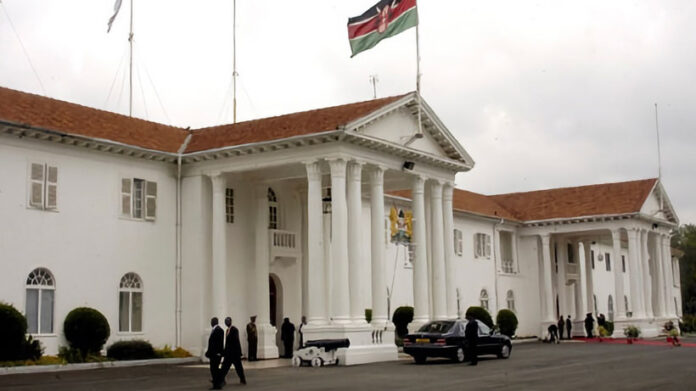
A High Court in Kenya has temporarily blocked the nation’s president from building a $9 million church at the State House, his official residence in Nairobi, citing constitutional concerns about the state’s secular identity.
Last month, as his plans came under increasing scrutiny—including criticism by the nation’s Anglican archbishop, Jackson Ole Sapit—President William Ruto vowed not to apologize for proposing the 8,000-seat church.
Ruto, an evangelical, has made his faith central to his political identity. In 2019, while serving as vice president, he built a lavish chapel he called the “National Prayer Altar” at his official residence in Karen, a Nairobi suburb.
He has repeatedly said he would self-fund the construction costs, which are estimated at 1.2 billion Kenyan shillings ($8 million USD), as he did for the Karen chapel (though this claim is disputed by some of his political opponents).
Justice Enock Mwita of Milimani Law Courts’ Constitutional and Human Rights Division is not convinced that the president’s promises create enough distance between church and state. He issued conservatory orders on August 28 blocking construction of any permanent religious buildings within the precincts of State House, Nairobi and other official government residences across Kenya until November 18.
Conservatory-Orders-Construction-of-Church-in-State-HouseMwita’s orders respond to a petition filed on August 20 by the Kenya Human Rights Commission (KHRC), Transparency International Kenya (TI-Kenya), Inuka Kenya Ni Sisi!, and the Institute of Social Accountability. The petitioners argue that Ruto’s project violates Article 8 of Kenya’s Constitution, which establishes Kenya as a secular state with no official religion.
“I am satisfied that the application and petition (by the lobby groups) raise fundamental constitutional and legal questions touching on State and religion which require urgent investigation and further consideration by the court,” Mwita said.
Mwita has ordered Kenya’s Attorney General, Dorcas Oduor, to respond in writing to the issues raised by the petitioners within seven days, and has given direction about further investigation and hearings on the matter.
The Kenyan judiciary is still expected to rule on a separate legal challenge by Nairobi attorney Levi Munyeri to the president’s proposal.
NIA-Court-Petition-Construction-of-Church-in-State-HouseArchbishop Ole Sapit warned last month that the project sends the wrong message.
“I have no problem with building a place of worship. The problem is the location,” Ole Sapit told Kenya’s leading newspaper, Daily Nation, which broke the story on July 4.
“State House is the seat of power of a human institution called the government. The Church is a sanctuary to worship God, and it is supposed to be set apart from any unholy use—representing God’s kingdom,” Ole Sapit said. “When you have a Church in State House, which kingdom does it represent?”
Kenya’s Bench of Bishops backed Archbishop Ole Sapit’s contentions, issuing a statement on July 11 suggesting that “moderate prayer rooms can be created for the purposes of individual or private devotions for persons who must worship on the site.”
While the East African country has an estimated 85 percent Christian majority, the president’s proposal has sparked anger among some citizens, who are weighed down by economic and political grievances.
Muslims have asked Ruto to also build a mosque at the State House, and Nairobi’s Catholic archbishop, Philip Anyolo, has expressed concern about perceived bias.
There are already two small mabati (sheet metal) chapels on the grounds of Kenya’s State House, built several decades ago for the use of the complex’s staff. One is a Roman Catholic chapel and the other, commonly known as the “Inter-Denominational Chapel,” would be demolished and replaced by the new church building if Ruto’s plans advance.

Jesse Masai is TLC’s East Africa correspondent, a longtime journalist and communications professional who has worked in South East Asia and the U.S., as well as in his native Kenya.
