


There’s got to be some sort of amazing cosmic irony that Martin Scorsese has an exclusive TV show on Fox Nation. The streaming app, which exiled news host Tucker Carlson once privately dismissed for how much it “sucks,” now also hosts the Fr. James Martin S.J., with regular panel discussions by liberal Catholic scholars about gender non-conformity and social justice.
I can’t tell if that’s depressing or hilarious, but if nothing else, it makes The Saints interesting. Scorsese’s lapsed Catholicism haunts his entire body of work, but this is among his most overtly sympathetic explorations of faith, and far less provocative than his biblical epic The Last Temptation of Christ or his adaptation of Shūsaku Endō’s Silence (or his next Endō adaptation, A Life of Jesus).
The series is now well into its second season—having already covered some hefty material, including St. Patrick, St. Francis of Assisi, St. Joan of Arc, St. Moses the Black, St. Carlo Acutis, and multiple apostles—but one episode in particular caught my eye earlier this month, his treatment of the English martyr St. Thomas Becket.
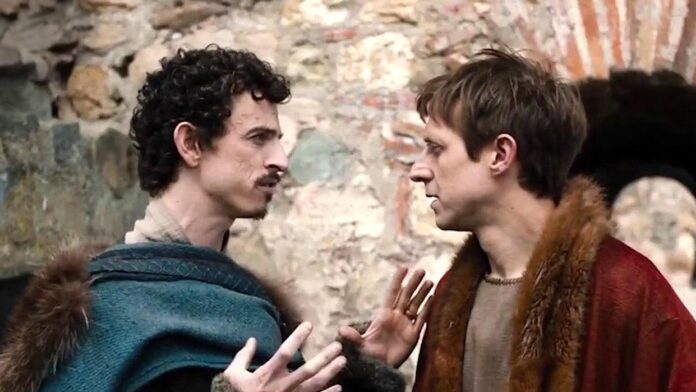
Over the course of the hour-long documentary, Scorsese narrates a dramatization of the Catholic saint’s rise to power and martyrdom in the 12th century, highlighting the challenges of living out one’s faith amid political corruption and moral compromise.
“The story of Thomas Becket is the story of the pitched battle between church and state in England, of which institution would win ultimate power over the other. The battle over the divine right of kings happened over hundreds of years and left a long line of martyrs in its wake. Becket was the most famous, so famous that Henry VIII tried to wipe his memory from his existence.”
As Scorsese describes Becket, he was “a man of great ambition,” a peasant from Norman immigrant parents, who rose through the ranks of the clergy amid the tumultuous reign of Henry II to become the second-most powerful man in England. This ambition, however, becomes a spiritual battle as he comes to recognize that his “weaknesses for the things of this world” require him to embrace an asceticism and independence that put him at odds with the monarch.
This would boil over into murder when deep conflict erupted, as Becket refused to cooperate with Henry on matters of justice and power, even excommunicating one of Henry’s bishops. The feud would escalate to the point that several of Henry’s most ambitious knights would take it upon themselves to besiege Canterbury Cathedral, killing the bishop in front of his monks as he clung to one of its pillars.
“Within three years of his death, he was canonized by Pope Alexander,” Scorsese says. “Legions of pilgrims from all over Europe made their way to Canterbury. Henry … allowed himself to receive a public but mostly symbolic flogging by the hands of Becket’s monks. In the struggle for power between the king and his Archbishop, Beckett had the last word.
“But the war between church and state went on for centuries. Three hundred and fifty years after Becket’s death, Henry VIII, who was bent on destroying the Catholic Church in England so that he could divorce his wife and remarry, took revenge. The name and likeness of Thomas Becket was removed from England, from every missal and every prayer book. But his name is remembered, and his saint’s day is still celebrated.”
The show’s presentation, with its borderline hagiographical depiction of the saint compared with his cynical power-seeking rivals, frames the martyrdom within an overly Roman Catholic lens, even taking potshots at the English Reformation. At times, it also exaggerates King Henry II’s faults, portraying the historically ambitious king as a slimy villain rather than the complex ruler whose administrative reforms made him one of the greatest kings of England.
However, the overall depiction of Becket’s life is nuanced. The act of inheriting episcopal power at that time was to become caught in a challenging game of politics in which the individual must always point toward Christ, a feat many bishops failed at as they were consumed by greed, lust, and wealth. As Scorsese notes, Becket “walked a political tightrope” in which it wasn’t uncommon for bishops to be exiled for their efforts. He was “maintaining the political balance between the church and the king, between defiance and compromise.”
At other times in history, this balance would boil over more intensely. Pope Innocent III would place an interdict against England in 1208 over a dispute with King John, which meant that sacraments were illegal to administer to the entire country for six years. In 1570, Pope Pius V would encourage English Catholics to violently revolt against Queen Elizabeth and overthrow the Protestant government.
For Scorsese, the life of Becket raises questions of how to find God in politics. He wonders if the Holy Spirit moves through our modern political systems and if God can enlighten us to make the right decisions in organizations predisposed to corruption and worldly ambition.
During a post-show discussion, Fr. Martin points out that the church is a political institution in the world, with access to vast real estate and influence over nations. That power has waned in recent centuries, particularly with the fall of the Papal States, the Enlightenment, the rise of democracy, and the Reformation, reducing its power over European monarchs.
Catholic writer and Georgetown scholar Paul Elie builds upon this, arguing that “the way of the world” is to be in tension, and powers struggle amid ambition and conspiracy. Indeed, Becket wasn’t able to fully transcend those challenges in his life, living a life of wealth and ambition above the station of what Christ asks from his followers. Regardless, Becket is still a saint.
The battle between Henry and Becket was ultimately about “politics and games of power.” However, Becket “was able to fully express his faith and serve his God only with his own death.” As Scorsese argues, his martyrdom allowed him to look beyond the world into “the heart of the mystery.”
Anglicans retain complex and contested perspectives on Becket to this day. He’s venerated by some Anglo-Catholics, as evidenced by the great poet T.S. Elliot’s remarkable dramatization of his martyrdom, Murder in the Cathedral. He also presents theological challenges that Reformation theology finds problematic.
Former Archbishop Justin Welby, who shared his See of Canterbury, praised Becket as “a figure who brings us together and enables us to reflect on the task and call of the church in the light of the challenges we face in modern Europe.” Conversely, John Boys, dean of Canterbury in the 17th century, dismissed him as “a bad subject in his life, and no good Christian at his death.” The Puritan Anglican John Foxe dismissed Becket as a rebel and “not a Martyr, but a stubborn man against his King.”
Nevertheless, most of the modern Anglican Communion continues to celebrate his feast day on December 29. More than 800 years after his death, he remains a powerful symbol of unity and clarity in church politics and ecumenical dialogue. Canterbury Cathedral’s allowance of Roman Masses in recent years has permitted greater Anglican-Catholic unity, and shows that his tomb remains a powerful space to this day.
To be a Christian is to be imperfect, as Becket was, but it is enough to point to Christ. Indeed, the show’s scholars argue that it was this act that made such a complicated man into a holy man. As Catholic poet Mary Karr points out in the concluding remarks of the discussion, it’s the hopes and prayers of Becket’s followers that have sanctified Canterbury Cathedral.
They’ve brought their fears and pain to the place where Becket’s blood was spilled wrongly, and this has set it apart as a holy place. He showed as well as anyone how a compromised man could still point to the final victory of Christ. He captures our hope to transcend the pains of humanity by leaning entirely on Christ.

Tyler Hummel is a freelance writer based in Lake Geneva, Wisconsin.
