


The Choral
Directed by Nicholas Hytner
Sony Pictures Classics/BBC Films
The Choral opens in 1916 with smoke billowing across an open field. Along the horizon, the heads of what appear to be soldiers are advancing toward us. Anticipating a scene from the Western Front, a different kind of hunting party then emerges. It is grouse shooting season in West Yorkshire, England. The movie begins with a visual joke—a kind of double take—to caution viewers not to trust their first impressions.
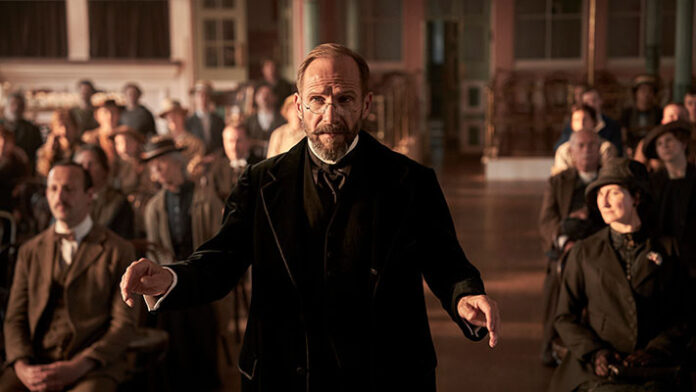
This is a war film, albeit one without trenches or battlefields. The action takes place in the village of Ramsden, West Yorkshire. The war’s shadow looms over the lives of the people of the village who gather every year to hear a musical piece performed by its choral society. With so many men away at the front—including the choirmaster, who has decided to volunteer—the choral society recruits Dr. Henry Guthrie (Ralph Fiennes) to rehearse and present this year’s concert.
Dr. Guthrie is greeted with suspicion, having recently lived in Germany, the land of the Bosch. The proposed choral piece—Bach’s St. Matthew’s Passion—is soon discarded in favor of a more patriotic oratorio, The Dream of Gerontius, with a libretto by John Henry Newman and music by the consummate Victorian composer, Edward Elgar. Guthrie gradually gains the trust of the choir by his professionalism and dedication to the task. Sometimes he is stern, at other times sympathetic and understanding. His passionate belief in their ability to sing draws the best out of the choir.
The main scriptwriter for The Choral is Alan Bennett, who first came to the attention of the British public as long ago as 1961. He appeared then as part of the groundbreaking revue Beyond the Fringe, alongside Peter Cook and Dudley Moore. Later, he established a reputation as a playwright. The Choralmay well be his swan song at 91.
Bennett has created a tableaux of characters that wonderfully reflect village life in all of its diversity. We meet the young men, not old enough to be conscripted, who are eventually drawn into singing for the choir. Among them is Lofty (Oliver Briscombe), who delivers telegrams with news of those either dead or missing in action. We meet the women, old and young, including Mrs. Duxbury (Eunice Roberts), who is mourning the loss of a son. The prim and proper Mary Lockwood (Amara Okereke) sings one of the main parts, while fending off the amorous attentions of fellow choir member Ellis (Taylor Utley).
Director Nicholas Hytner, who first worked with Alan Bennett on The Madness of King George over 30 years ago, has assembled an impressive cast. There are multiple stories, some overlapping, and it is a measure of his skill as a director that Hytner has brought them together without in any way overloading the story. He is like a British version of Robert Altman, who pulled off a similar feat with Nashville.
The drawback is that, as we delve into the life of the village and its people, we don’t come to know the characters in any depth. Sometimes, however, the human face tells its own story. In this regard, it is hard to imagine a better performance than that of Ralph Fiennes, who is able to convey the toughness and vulnerability of the outsider.
The Choral casts its thematic net wide, seeking amid the various personal stories to comment on xenophobia, homophobia, and that perennial theme of British drama, the class system. It is surprising that the mill owner, Alderman Duxbury, played by the ever reliable Roger Allam, is portrayed so sympathetically. The same cannot be said for Sir Edward Elgar (Simon Russell Beale), whom Bennett has unfairly maligned.
I said that this is a war film. Actually, it would be truer to say it is an anti-war film. Or, at least, it celebrates the victory of the human soul over the degradation of war. It does this through the humanity of its characters and by the redeeming influence of art—in this case, the power of music to uplift and heal.
The Rev. David Beresford is a retired priest who lives in Wilmington, Delaware. He writes a weekly blog at davidberesford.net.
