


Daily Devotional • December 7
A Reading from Amos 6:1-14
1 Woe to those who are at ease in Zion
and for those who feel secure on Mount Samaria,
the notables of the first of the nations,
to whom the house of Israel resorts!
2 Cross over to Calneh and see;
from there go to Hamath the great;
then go down to Gath of the Philistines.
Are you better than these kingdoms?
Or is your territory greater than their territory,
3 you who put far away the evil day
and bring near a reign of violence?
4 Woe to those who lie on beds of ivory
and lounge on their couches
and eat lambs from the flock
and calves from the stall,
5 who sing idle songs to the sound of the harp
and like David improvise on instruments of music,
6 who drink wine from bowls
and anoint themselves with the finest oils
but are not grieved over the ruin of Joseph!
7 Therefore they shall now be the first to go into exile,
and the revelry of the loungers shall pass away.
8 The Lord God has sworn by himself
(says the Lord, the God of hosts):
I abhor the pride of Jacob
and hate his strongholds,
and I will deliver up the city and all that is in it.
9 If ten people remain in one house, they shall die. 10 And if a relative, one who burns it, takes up the body to bring it out of the house and says to someone in the innermost parts of the house, “Is anyone else with you?” the answer will come, “No.” Then the relative shall say, “Hush! We must not mention the name of the Lord.”
11 For the Lord commands,
and he will shatter the great house to bits
and the little house to pieces.
12 Do horses run on rocky crags?
Does one plow the sea with oxen?
But you have turned justice into poison
and the fruit of righteousness into wormwood,
13 you who rejoice in Lo-debar,
who say, “Have we not by our own strength
taken Karnaim for ourselves?”
14 Indeed, I am raising up against you a nation,
O house of Israel, says the Lord, the God of hosts,
and they shall oppress you from Lebo-hamath
to the Wadi Arabah.
Meditation
Amos speaks into a time (8th century BC) of relative prosperity for the northern kingdom of Israel. The famous words of the opening of this chapter are aimed at the complacent self-satisfaction of the Israelites: “Woe to those who are at ease in Zion!” This verse has often been applied to our own culture’s extreme consumerism and the politics that upholds it. Amos looks at his society and announces “Woe,” an interjection of alarm and sorrow, like the English “Alas,” or simply a gasp of horror “Ah,” uttered in the face of fear and lostness. His reaction stands in stark contrast to the sense of security and tranquility felt by his compatriots.
This sense of security is deceptive, because bought at the price of faithlessness: at any moment, it will crumble. You are like everyone else, Amos tells Israel the mirror of the enemy nations around you, falsely believing that God’s judgment is only aimed at others, not at themselves. Israel claims its wealth and military success is of their own making, when in fact, as a human work, it is a “nothing,” a fact proven by what God will do to it: leave it in ruins. Amos doesn’t soften his message of divine judgment and its destructiveness. It is part of what makes reading him difficult and bracing. God shows mercy, in Amos’ visions, in both small and large ways, but never to the exclusion of the dissolving power of His condemnation.
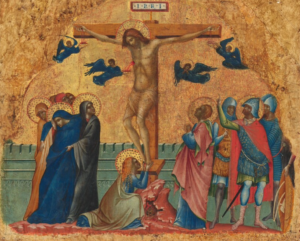
Christians believe that Jesus is at the center of this divine judgment and mercy both. We rightly see in the Cross God’s mercy and forgiveness. This is so only because the Crucifixion literally bears God’s judgment, not making it disappear but displaying it in the body of His son. We listen to Amos not as a now bypassed prophet of outdated divine judgment, but because he can show us how following Jesus means entering into that judgment’s meaning, one that always “begins with the household of God,” the Church, our own lives! (1 Pet 4:17). In following Jesus, we enter into a strange and trembling intimacy with God’s own life. Amos looks at our world, at us, and sees not hopelessness but rather God’s character of righteousness and purity, a vison of which is the foundation of God’s grace in Christ. This is why we begin our life with God in repentance: “Repent ye, and believe the Gospel” (Mark 1:15), the first words of Jesus’ ministry.
The Rev. Ephraim Radner, PhD is Professor Emeritus of Historical Theology at Wycliffe College at the University of Toronto. The author of over a dozen books, Dr. Radner was previously rector of the Episcopal Church of the Ascension, Pueblo, Colorado. His range of pastoral experience includes Burundi, where he worked as a missionary, Haiti, inner-city Cleveland, and Connecticut.
♱
Daily Devotional Cycle of Prayer
Today we pray for:
The Church of Bangladesh
St. Bartholomew’s Episcopal Church, Nashville, Tennessee
This ministry of The Living Church Foundation is made possible in part by a special bequest from the Anglican Fellowship of Prayer.

The Rev. Ephraim Radner, PhD is Professor Emeritus of Historical Theology at Wycliffe College at the University of Toronto. The author of over a dozen books, Dr. Radner was previously rector of the Episcopal Church of the Ascension, Pueblo, Colorado. His range of pastoral experience includes Burundi, where he worked as a missionary, Haiti, inner-city Cleveland, and Connecticut.
