


An Interview with Rob Withem
I Felt Called has generated positive press. Are you happy with the album’s reception?
Yeah, I’m happy anybody even pays attention to the band after all these years. I feel very grateful to be able to continue to write, record, and release albums.
I was surprised to read in a recent interview that you do not consider yourself a lyric writer. And yet the lyrics on I Felt Called often cohere around the unwilling disorientations of middle age. What do you want listeners to know about the lyrical content of the new album?
Well, when I say I’m not a lyric writer, it means that I don’t sit down with like a pen and a notebook and say, “I’m going to write a song about XYZ.” I’ve never been able to do that without feeling quite ridiculous. After a lot of years of doing this, I’ve found some ways that work for me to write lyrics, and it’s basically 50 percent chance and 50 percent connecting the dots.
I think beautiful music can stand alone without lyrics or with very basic lyrics, so for me the words are primarily a vehicle for melody. But it’s amazing the things that come out when you aren’t really trying to be a poet, that you never would have come up with if you were trying. … It’s a very weird business.
As a listener, I find it difficult to determine when a song is personal for a songwriter. But I’m struck by some of your lyrical juxtapositions. Are the thematic contrasts on I Felt Called intentional?
The title of the album is really a play on the common Christian cliché where someone says they felt God called them to this or that, thereby shutting down any pushback or critique, because in their mind they are divinely inspired in whatever it is that they are doing.
It’s a phrase intended to inflate the importance of whatever you already want to do into something spiritually significant that somehow you alone can see because you felt the calling. As I’ve grown older, I’ve seen the folly of this in my own life and in others. When we are the most certain of some calling tends to be when we are most likely to fall out of it into the ordinary and mundane. We think we are so important, and our ambitions are so worthy of divine affirmation, when in reality we ought to decrease as Christ increases.
Certainly he calls us, but more often than not, in my experience, this is a call to humility and self-forgetfulness and the ordinary means of grace, rather than some grand scheme upward, or toward our hearts’ desires.
As far as the intentionality of the lyrical contrasts, I hadn’t really thought about it that way. But I suppose life is really full of those contrasts. Age has a way of making you more serious and circumspect about the hard realities of life, but it also has made me keenly aware of how funny and absurd some things are. I became a grandpa this year, and I guess that’s how grandpas are supposed to be—grumpy and funny.
Reaching back a bit, on 2018’s Not Thrilled you have the song “The Hymnal 1982.” What is it about?
I grew up basically wandering around our Baptist church on weeknights when my mom was leading choir rehearsals, or my dad was teaching Bible studies. To this day I love being alone in an empty church and exploring the various rooms and spaces. I was probably 7 or 8 years old when I stumbled across the cabinet where the church kept the Communion elements—the little hard wafer things and the Welch’s grape juice (we were Baptists, of course).
I have no idea why, but I ate a bunch of the wafers, and then spent the next years of my life riddled with guilt at what I had done, taking the body of the Lord in an unworthy manner. This incident kind of illustrates my faith as kid who grew up in the church and has never known a day that I didn’t know Christ.
But I was scared to death of God. So the song is kind of about that. But unlike many who grew up like I did and have now deconstructed and abandoned the faith, my life has been haunted by Christ and the gospel, and by his grace I’ve been able to walk with him and lead my family in that as well.
Why the song title?
I remember seeing that dark blue hymnal with the words The Hymnal 1982 in gold on the cover, and at some point years ago I realized how great a song title it would be. So I just hung onto it until I had a song where it seemed to fit.
Are you involved in any other artistic or musical projects?
I’ve always got a few things going on. I contributed some guitars and keyboards for the new Starflyer 59 album that came out last fall, and I’m currently helping my daughter Lydia with recording some of her instrumental compositions.
Day job: I own a construction company.
Currently reading: Out of the Ashes by Anthony Esolen; Endurance: An Epic of Polar Adventure by F.A. Worsley
Currently listening to: Harp, Albion; Judy Collins, Judith; David Sylvia, Gone to Earth
Favorite poet or author: Wendell Berry
Favorite gear: Fender Telecaster, Fender Deluxe Reverb (amp), vintage Boss CE-2 Chorus Pedal
Sass Sings Sweetly
I Felt Called
Fine China
VelvetBlueMusic.com, $11.49 and up
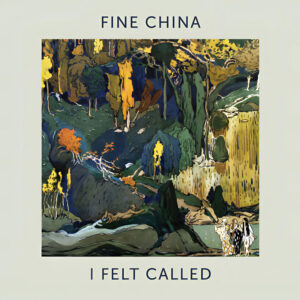 The first single from Fine China’s I Felt Called is the punchy, hook-laden “Gonna Need a Vacation,” an upbeat anthem that evenly splits the lyrical difference between introspection and sardonic commentary. Frontman Rob Withem’s chorus is a blunt exhortation sung above an otherwise peppy riff: “Stop being so emotional / start being locomotional.” And as the last verse ends, he adds, “You got too much education, so be the guy / who takes the boat out on the weekend / dry your eyes.” It’s as melodic as it is confident, arranging the solo to begin shortly before the song fades out. Even if you are too serious-minded to dance, “Gonna Need a Vacation” should at least elicit a generous moment of self-deprecating laughter.
Musically, this album is Fine China’s most lush production yet. Withem and company deftly exploit the possibilities of the stereo field, with numerous parts double-tracked. Some of their finest compositional self-discipline is found in the subtle ambience that slowly crescendos in the openings of “No Long Face” and, most impressively (at more than two minutes), “Desert of My Dreams.”
The most notable influences are probably British bands from the 1980s, such as Echo and the Bunnymen or The Smiths, but the keyboard contributions are especially ample, witnessing to Withem’s interest in New Age music. But every song stresses melody, and unlike the lyrical tendencies of those British bands, the lyrics never crowd out the musicianship.
Thematically, the album ranges across the middle of life. Nostalgia and disappointment sometimes intertwine. “Television Set” looks back. The chorus begins with “I just wanna watch the television / to get back to 1987 / when hearts were live.” Similar is “Say Please”: “I want things like at the dawn of life / when everything was fine / now it seems like this is not my life.”
None of this is especially glum, but there are more explicitly somber moments with “I Felt Called,” and “Desert of My Dreams,” with its reverb-heavy plaint, “Do you run long? / I have run long / in the desert of my dreams.” But listen closely here. Even the more upbeat tracks, such as “Mauve Decade,” offer diverse shades of existential authenticity. And as in real life, the love song “Pedal to the Metal” offers an arresting reprieve amid the quotidian blur: “Saw you in the meadow / your bow strung an arrow / and you shot me straight through the heart.” Withem’s lyrical meditations are relatable in every way.
I Felt Called is one of the great albums of 2025.

Benjamin M. Guyer, PhD is a Guest Writer. He is a lecturer in the Department of History and Philosophy at the University of Tennessee Martin. The author or editor of five books, Guyer is a Fellow of the Royal Historical Society, serves on the Advisory Board of Anglican & Episcopal History, and is Associate Book Review Editor for the Sixteenth Century Journal.
