


Daily Devotional • December 12
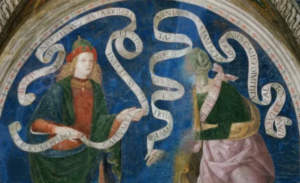
A Reading from Haggai 1:1-15
1 In the second year of King Darius, in the sixth month, on the first day of the month, the word of the Lord came by the prophet Haggai to Zerubbabel son of Shealtiel, governor of Judah, and to Joshua son of Jehozadak, the high priest: 2 “Thus says the Lord of hosts: These people say the time has not yet come to rebuild the Lord’s house.” 3 Then the word of the Lordcame by the prophet Haggai, saying: 4 “Is it a time for you yourselves to live in your paneled houses, while this house lies in ruins? 5 Now therefore thus says the Lord of hosts: Consider how you have fared. 6 You have sown much and harvested little; you eat, but you never have enough; you drink, but you never have your fill; you clothe yourselves, but no one is warm; and you that earn wages earn wages to put them into a bag with holes.
7 “Thus says the Lord of hosts: Consider how you have fared. 8 Go up to the hills and bring wood and build the house, so that I may take pleasure in it and be honored, says the Lord. 9 You have looked for much, but it came to little, and when you brought it home, I blew it away. Why? says the Lord of hosts. Because my house lies in ruins, while all of you hurry off to your own houses. 10 Therefore the heavens above you have withheld the dew, and the earth has withheld its produce. 11 And I have called for a drought on the land and the hills, on the grain, the new wine, the oil, on what the soil produces, on humans and animals, and on all their labors.”
12 Then Zerubbabel son of Shealtiel and Joshua son of Jehozadak, the high priest, with all the remnant of the people, obeyed the voice of the Lord their God and the words of the prophet Haggai, as the Lord their God had sent him, and the people feared the Lord. 13 Then Haggai, the messenger of the Lord, spoke to the people with the Lord’s message, saying, “I am with you, says the Lord.” 14 And the Lord stirred up the spirit of Zerubbabel son of Shealtiel, governor of Judah, and the spirit of Joshua son of Jehozadak, the high priest, and the spirit of all the remnant of the people, and they came and worked on the house of the Lord of hosts, their God, 15 on the twenty-fourth day of the month, in the sixth month.
Meditation
The short book of the prophet Haggai falls within the period referred to in Ezra 4:24-5:2: rebuilding Jerusalem’s Temple following its destruction by the Babylonians. After the initial project was abandoned in 535 BC, Haggai brings God’s word to the Jewish governor Zerubbabel and the priest Joshua to take up the work again and finish it. The opening verses of the book contain some of the Bible’s greatest words of divine encouragement: “I am with you!”
But we should note that “encouragement” implies giving courage where it does not already exist. There is a movement from a “before” (no courage) to an “after” (courage). In this case, the discouragement of “before” is obvious: a destroyed Temple; and encouragement is provided by the divine command and promise. For Israel, in fact, courage almost always comes in a movement of re-building. Israel is a constantly rebuilding nation, from the tablets of the Law (Exod 34:1-4, 28) to Temples, to peoples (Ezek 37:16-24). This is Israel’s life: struggling, fallen, judged, chastised, encouraged, rebuilding. It culminates in the very person of the Messiah Jesus: “Destroy this temple, and in three days I will raise it up” (Jn 2:19). There is a profound correlation at work here that goes to the roots of our beings as creatures: What for God is a “new creation” (Is 65:17) is, in Israel’s human experience, always felt as a “rebuilding.” Thus, the new act of God’s salvation in the Messiah—“Immanuel”, God with us—is given as a renewal, a rebuilding of the relationship of God’s encouraging presence that has already appeared here in Haggai as the repair of a fallen Temple. The New Covenant in Christ is not severed from the past, but includes the whole story of Israel’s suffering, exile, and restoration. The soil of Israel’s history is rich with the blossoms of salvation.
Rebuilding therefore is the Church’s ongoing character too. God “builds” the church in a way that is permanently established (Mt 16:18). But the Church’s established life is given in her constant re-building, as it were, with parts made, taken away, and fashioned anew (1 Cor 3:9-15). It would be wrong to read this ongoing process as a mark of the Church’s hollowness. Rather, the Church’s fallibility—falling and being ever rebuilt—is the container of her divine “encouragement,” ever straining forward, in fear and trembling (Phil 3:13-14; 2:12). The Church embodies the promises made to Israel as much as anything: she rebuilds because she is ever encouraged by her Lord.
The Rev. Ephraim Radner, PhD is Professor Emeritus of Historical Theology at Wycliffe College at the University of Toronto. The author of over a dozen books, Dr. Radner was previously rector of the Episcopal Church of the Ascension, Pueblo, Colorado. His range of pastoral experience includes Burundi, where he worked as a missionary, Haiti, inner-city Cleveland, and Connecticut.
♱
Daily Devotional Cycle of Prayer
Today we pray for: